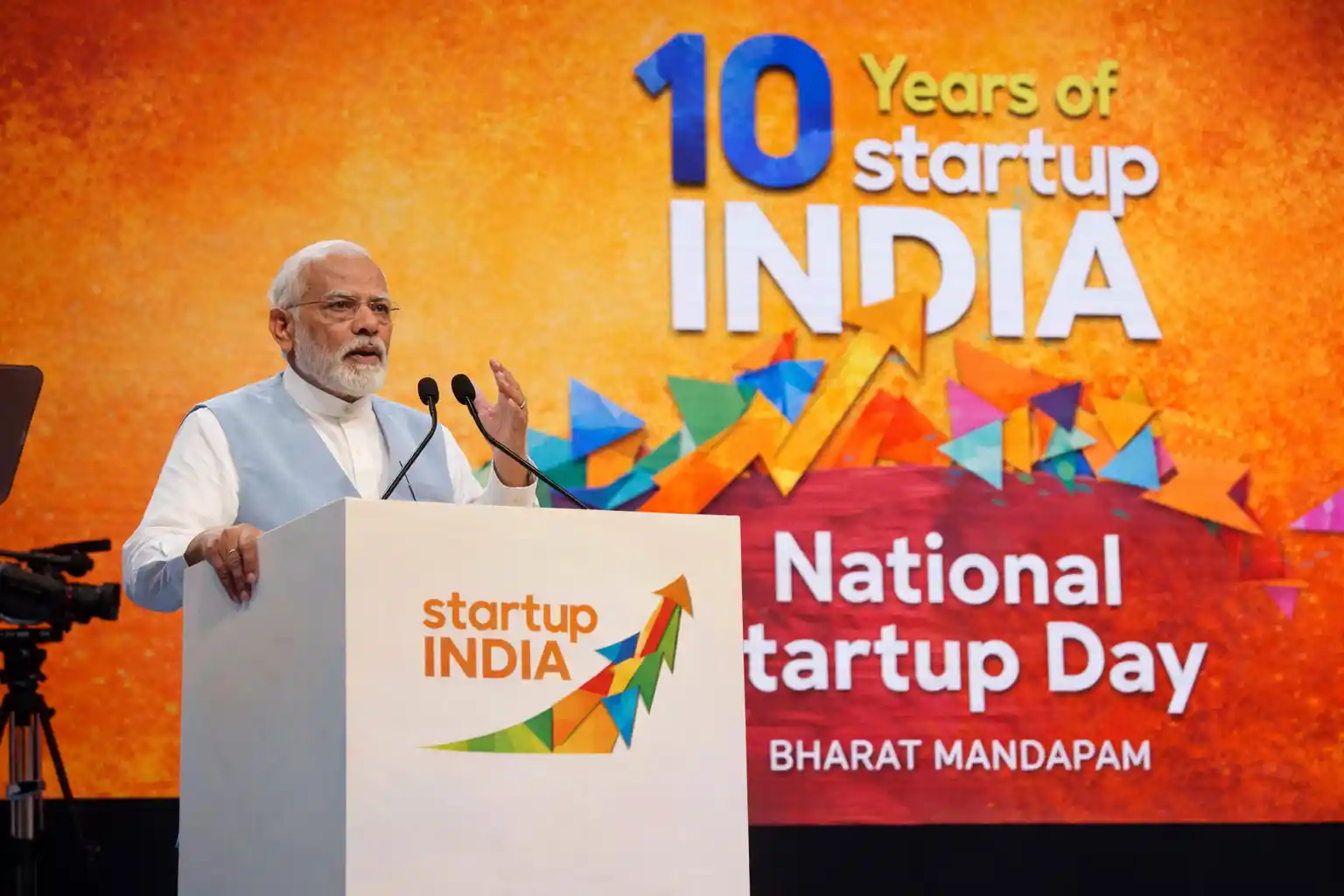
Decade of Startup India is Commemorated by Prime Minister Narendra Modi.
In the event that was organized on January 16, 2026, the Prime Minister declared that close to 44, 000 new startups were registered during the calendar year 2025 alone. It is the first time that the flagship scheme has been launched in 2016, and such figure shows the biggest annual addition to it since that time, based on official data published by the Department for Promotion of Industry and Internal Trade (DPIIT).
For advertisement on our platform, do call at +91 6377460764 or email us at [email protected].
The Prime Minister announced that India has now established itself as the third-largest startup ecosystem in the world with more than 200,000 established actors. He also reported that unicorns, or startups that are worth more than 1 billion dollars have increased to almost 125 active businesses currently as compared to only four in 2014. Government officials who were at the event argued that such growth is a direct product of a decade of policies-driven endeavors to open access to capital, as well as easing of regulatory compliance among young entrepreneurs in the country.
Indications show that Failure Rates are high as milestones of growth are achieved.
Even though the government has been celebrating the fact that it has registered the largest number of ventures, independent reports have shown a sobering trend about the sustainability of these new ventures. This is because according to statistics by different industry monitoring service providers, such as Tracxn and ScanX, a good percentage of startups that had been started within the last five years have been unable to survive. Other privatized analyses purported that the failure rate of Indian startups goes in the 90s in the first five years of operation, reflecting the global trends but emerging stronger in the 2025-2026 financial year.
Although the government noted that 6,385 known startups had been closed as of October 2025, critics and certain tech analysts claimed that the number was not representative of the full impact of the so-called silent closures occurring with unlisted startups or smaller startups. According to these analysts, the difference between the number of new registrations and sustainable businesses is expanding, and there is need to take a specific look at the churn of the ecosystem.
Hurdles to regulation mentioned as the main challenge to founders.
The role of government regulations and compliance requirements in the discussion of the issue of startup failures in 2025 has played a significant part. A report by a Medium-based tech observer Sachin Vishkarma has found approximately 19 per cent of contemporary startups failures can be linked to the legal and regulatory difficulties. The founders of Fintech, HealthTech, and education technology have claimed that the constant policy changes, especially the latest Reserve Bank of India (RBI) regulations on digital lending, and stricter data protection regulations under the DPDP Act have produced a crunching effect on early-stage businesses.
The bodies in the industry have asserted that, though there are a number of barriers that are eliminated by the government, including the so-called Angel Tax that will act starting April 2025, the general compliance environment will continue to be complex. Other entrepreneurs criticized the cost of legal and tax compliance as having been higher than the seed capital of a bootstrapped start up. These sources claimed that although the Startup India mission has managed to promote the spirit of risk-taking, the bureaucratic machinery of the state and the local level has not yet completely matched with the vision of the central government regarding a frictionless business environment.
Authoritative Reaction and further modifications in policy.
In a reaction to the high failure rates, Minister of State in the Commerce and Industry, Jitin Prasada told Parliament that the majority of startup closures are due to market viability factors and not to the systemic nature of the regulatory problems. The government argued that the rate of shutdowns in the year 2025 was the same as in the past years and there was no abnormal increase. Formal statements pointed to the possibility of failures being associated with poor unit economics, absence of product-market fit, or inability to find new sources of financing in a slowing global economy.
In an effort to overcome the adversities being experienced by the ecosystem, the government declared the launch of Fund of Funds 2.0 in April 2025 with the corpus of 10,000 crore, in this case, with focus on deep-tech and AI-based startups. According to the officials, the purpose of this move is to give long-term patient capital to business segments in which research and development is a slow process. The government still believes that the current recalibration of the ecosystem is an indicator of market maturity as the independent observers insist on a more simplified and trust-based regulatory framework to safeguard the record number of new entrants.