For advertisement on our platform, do call at +91 6377460764 or email us at [email protected].
Weather forecast is not looking very promising this year! The forecast of the India Meteorological Department is quite dry in the coming months. The coming months are the weakest monsoon in 11 years.
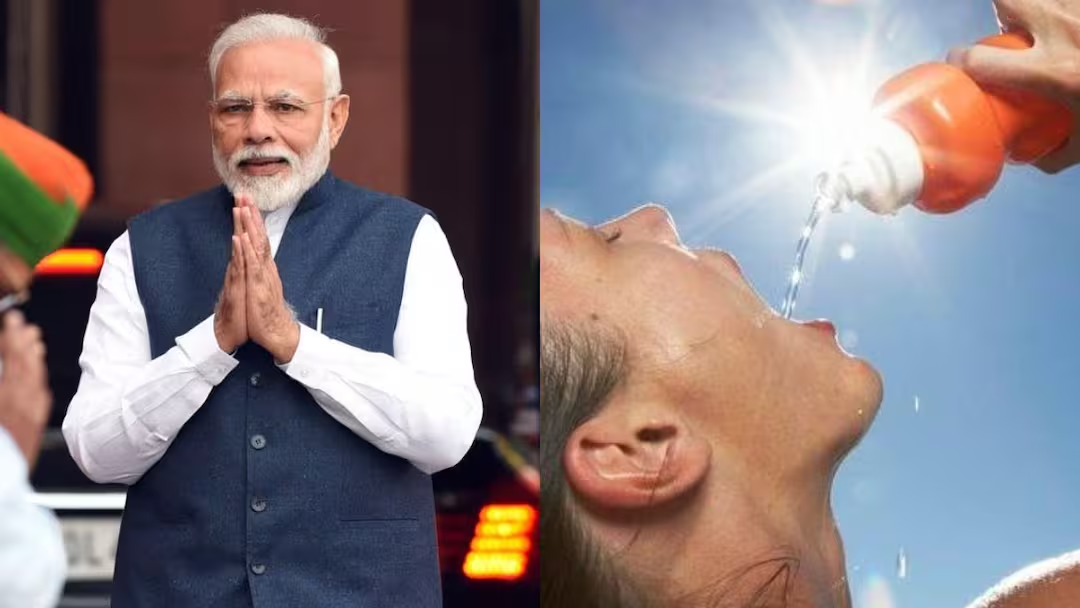
This week Prime Minister Narendra Modi sent a public warning of a plain and simple kind. Many regions of the nation are already experiencing heat stress. The problem is, though, what happens after. He informed citizens that they must be prepared to deal with the impact of an impending El Niño weather pattern. The message was simple. Stop wasting water. Hydrate. Make sure to keep an eye on those around you who may not make it through a vicious summer afternoon
He particularly requested to place water containers for roaming animals and birds. It’s a seemingly simple action. But once temperatures break 45 degrees, surface water evaporates in hours. Birds literally fall out of the sky. Inevitably, it’s a matter of basic community consciousness, such as passing a glass of water to a delivery rider or a worker earning a daily wage, which could either make or break the difference between a hard day’s work and a deadly heat stroke, Modi said.
He cautioned against the “common sense” of dismissing early physical warning signs. Dizziness, nausea and bizarre bouts of fatigue aren’t something you can shrug off on a really hot day. Oral rehydration fluids and immediate shade should be provided to anyone who appears weak. Untreated symptoms can rapidly escalate to life-threatening heatstroke. It is not the norm in summer. The government is obviously nervous about the math.
The Eleven-Year Low
There’s a lot of panic to see in the Pacific Ocean. The occurrence of El Niño is related to a rise in the temperature of the sea surface in the central and eastern Pacific. The heating wreaks havoc with the world’s winds. It is like a big obstacle in front of the monsoon clouds making their way up from Kerala coast for India.It is sort of a big obstacle present in front of the monsoon clouds which try to push up from the coast of Kerala for India.
The IMD have just revised down their forecast. At first they were expecting us to receive some 92 per cent of the long-period average rain. Now they say it will hit 90 percent. When you take the subcontinent into consideration, that two percent is a huge drop.
The chances of a downright deficient monsoon are now 60 percent. We haven’t seen conditions this bad since 2015. El Niño withheld rainfall to eighty-seven percent that year. Crops failed. Farmers protested. The rural economy was dealt a severe blow.
Almost 70% of the annual rainfall in India is received during the monsoon. It’s the lifeblood of a four-trillion dollar economy. Without all those rains, the costs of vegetables, electricity grids and everything else is completely knocked off kilter. The Earth Sciences Ministry’s secretary M. Ravichandran confirmed that El Niño is moving in to a transition phase right now. It is expected to increase in strength from weak in June to moderate in July, reaching strength of moderate to maximum in September. This is the time at which India is in dire need of intense rainfall.
Farms on the Brink
Agriculture minister Shivraj Singh Chouhan is already warning the state governments. He instructed them to be prepared with contingency plans as soon as possible.
It’s a bad time! It’s now the Kharif season, which is coming our way. It is expected that millions of farmers would begin sowing their summer crops in June. The Federal government has stocked enough seeds and fertilizers, Chouhan stated to the press. However, if the soil is extremely dry, fertilizers will be worthless.
The IMD has announced that June will be a particularly tough month. They have forecast below normal rainfall for most parts of the country for next month. Some isolated pockets, in the south and in the northeast, may occur, but these are the only exceptions.
To add insult to injury, the heat wave is not subsiding. The meteorological office says up to six days of heatwave conditions are forecast for the June period, when the average is just three. These are the States of Uttar Pradesh, Haryana, Punjab, Bihar, Odisha and Andhra Pradesh. Heat stress is high for in-ground crops.
Agricultural damage is real. This is what is already taking place. Consider the mango exports industry. The heat wave at home is majorly affecting the crop harvests. Just to make matters worse, the Japanese inspectors discovered the critical loopholes in a vapor heat treatment plant in Uttar Pradesh just now. Japan completely stopped Indian mango shipments. Top-quality varieties such as Alphonso and Kesar are suddenly cut off from a huge overseas market for the season. One disruption has the potential to cost an industry nearly fifty-six million dollars. That’s only one crop! Add that kind of stress on wheat, rice and pulses.
Empty reservoirs and Power Grids
The reservoirs also must be taken into account. The large dams play a crucial role in India maintaining water supply during lean seasons. However, when the monsoon fails to fill up these cities, they are in trouble for drinking water.
Then the electric problem. Hydro-electric stations are required to turn off their turbines when they are not able to reach a sufficient water level. The country has already met the national energy constraint. Global fuel supplies are totally unpredictable at present due to the continuing geopolitical turmoil in West Asia. A complete loss of domestic hydropower at the time air conditioning demand is high throughout urban India guarantees huge rolling blackouts.
The Indian Ocean Dipole is in a neutral state at the present time. A positive dipole can also compensate for the impact of El Niño by warming up the western Indian Ocean and bringing moisture to the subcontinent, in some cases. But meteorologists are not optimistic that it will be strong enough this year to fight off the Pacific warming.
It is anticipated that the monsoon would reach Kerala around the first week of June. However, extended forecasts indicate mostly dry weather over the southern coast well into the second week of the month.
This is being seen as a slow moving disaster. Administrations are reminded to prepare cooling shelters and procure safe drinking water. Mass heat casualties are being preplanned for on emergency response systems.