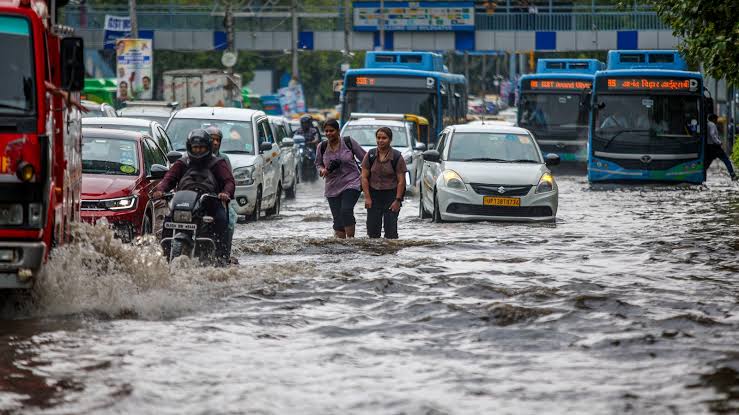
Heavy rains lashed Delhi, the capital of India, on Tuesday, 28th July, 2026, causing widespread waterlogging, traffic congestion and disruptions across the city.
For advertisement on our platform, do call at +91 6377460764 or email us at [email protected].
Several roads and low-lying areas in Delhi, including Connaught Place, Janpath, Bharat Mandapam Road, Barakhamba Road, Mathura Road near ITO and Kalindi Kunj, were inundated. Large pools of water stopped or slowed traffic, while commuters navigated submerged stretches on roads, amid poor visibility caused by overcast skies and gusty winds.
Traffic congestion was reported from Greater Kailash-II, Hauz Khas, RK Puram, NH-8 near Shankar Vihar, NH-48 near AIIMS, Delhi-Noida Road, Kalindi Kunj, Vikas Marg and other arterial roads. Visuals from several parts of Delhi showed waist-deep water on roads, with schoolchildren and commuters wading through flooded streets.
Water logging on roads has become a permanent feature in many cities of India during the monsoon season ( July to September ). What is its cause ?
Anyone who has studied history knows that our ancestors, the people of the Indus Valley Civilisation, built cities and towns with excellent drainage and sewage systems 5000 years ago. Since then have we in India moved forward or backward ?

The misery which has unfolded in Delhi is not unique to it. All across India, from Srinagar to Chennai and Mumbai to Dibrugarh, rain is inevitably followed by water-logging on the streets of cities, causing immense suffering to the people. In September 2014, heavy rains turned the capital of Jammu and Kashmir into a lake, with many localities submerged under 20-30 feet of water. In my home town of Allahabad, many localities like Allahpur and Mumfordganj go under several feet of water every year after heavy rains. Kolkata’s waterlogged streets are well known, and parts of Delhi, e.g. Minto Bridge, have severe waterlogging in the monsoons. What is the cause of this?
The reason is simple to understand. Greed has destroyed our drainage systems.
Rains come every year in the monsoon or rainy season, and so there has to be a proper drainage system to take away the water to the nearest river, otherwise it will accumulate and cause waterlogging. Historically, indeed all the way up to British rule and for some time thereafter, there were excellent drainage systems in every city in India, which were properly maintained by the municipalities.
Gradually, however, people, in their greed, illegally built houses, shops, and other buildings on the drains, obviously in collusion with municipality officials, thus blocking them everywhere. In Srinagar, people illegally filled up both banks of the Jhelum river with earth, and built houses and other buildings on them, thus narrowing the width of the river. Obviously it will overflow in the rains.
Why did the authorities allow this to happen? Obviously money must have changed hands. To make matters worse, successive governments at the Centre and in the states have not bothered to invest in urban infrastructure – especially drains, pipelines and sewerage systems – despite the growing population of our towns and cities.
Srinagar’s celebrated Dal Lake has shrunk by 10 square kilometres since 1953. The lake covered 25 square kilometre in 1953 but is only 15 sq km today. Massive encroachments, the erection of many structures, house boats and hotels have contributed to this reduction in the size of the lake. The depth of the lake has also been drastically reduced. Obviously when there are heavy rains, the lake will overflow its banks.
What is the remedy for this malady?
I am afraid there is none in the present system prevailing in India. The drains have been destroyed in many Indian cities due to corruption in the municipalities, which were supposed to maintain them. People have illegally built houses, shops etc on these drains, obviously by giving bribes to municipality officials. And since corruption is rampant in India, we have just to grin and bear this malaise, tribulation, and permanent nightmare.