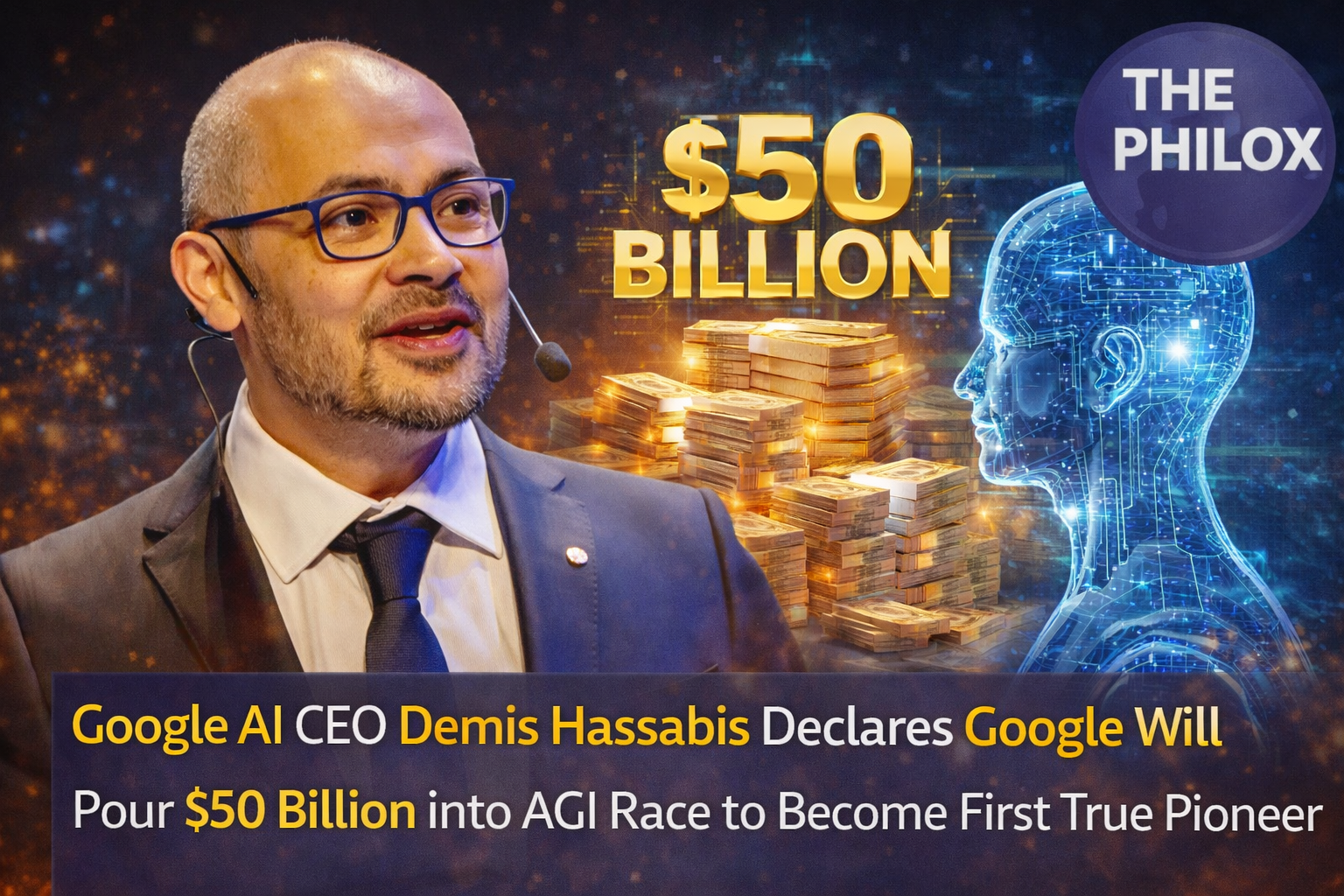
The Age of the $50billion AGI Age.
Google has formally stepped up the rivalry in the struggle of artificial intelligence on a global scale by making an eye-opening announcement that has rocked the world of tech. Demis Hassabis, the CEO of Google DeepMind has stated that the company will invest a colossal 50 billion dollars in a dedicated effort to win the race to Artificial General Intelligence (AGI). This is an unprecedented financial commitment, which means that Google is not content to be a party to the current AI boom but it is bent on becoming the head of the next epoch of human history. The amount of this investment alone is comparable to the budgets of most national space programs and this merely demonstrates how important the company is to the future economy and the discovery of science.
For advertisement on our platform, do call at +91 6377460764 or email us at [email protected].
This statement is made by the Nobel laureate and one of the most esteemed persons in the computer science field, and he has a clear vision of becoming the first real pioneer of AGI. He stressed that this financing does not only apply to updating the current chatbots and search engines with some minor changes, but rather implementing a radical breakthrough of developing machines capable of reasoning and thinking like people. The announcement is like a call to arms to the engineers and researchers of Google and it offers them virtual bottomless resources to address the most difficult of problems in mathematics and logic. This particular price tag on the project should send a signal to all investors and rivals that Google is committed to the ultimate prize of computer science.
The plan to this fifty-billion-dollar war chest is through uniting the huge research expertise of Google to a single mission of producing a machine with general purpose cognition. The subsidiary headed by Hassabis, DeepMind, has already acquired legend status in the ability to solve protein folding and master complex games such as Go, but AGI needs a far more extensive range of capabilities. The new capital inflow is likely to accelerate the appearance of “world models, which know physics and cause-effect, and not merely foretell the word that follows in a sentence. The idea is to get out of the jagged intelligence of the existing models – able to pass bar exams but unable to solve simple puzzles – to a sound system that never commits any hallucinated errors.
What is AGI: Defining the Holy Grail?
Artificial General Intelligence is a hypothetical endpoint on which a computer system will be as capable or more capable than humans of performing the full gamut of intellectual functions. In contrast to the modern narrow AI that is set to perform a set of distinct tasks such as writing an email or driving a vehicle, AGI would be able to learn any intellectual activity that a human being is capable of doing. One of the most famous descriptions of this goal, given by Hassabis, is the possibility to create a machine which can be used as a scientist so as to cure all the diseases or to resolve the climate crisis. The investment is actually a gamble that a digital polymath can be built during our lifetime and can open the trillions of dollars in value to the company that owns it first.
The development of AGI is simply unlike creating more efficient search engines since it involves the system to have independence and real knowledge. The existing Large Language Models (LLMs) are amazing simulators of the way humans speak, yet they do not always have the logic or the so-called common sense behind the words that even a child can have. Included in the fifty-billion-dollar roadmap (probably) would be the financing of new cognitive architectures that simulate the human brain in its skill to plan into the future and negotiate new circumstances with no previous experience. In the case of Google, to do so would entail not just becoming an organization that organizes the information in this world but also, one that comprehends and generates new knowledge.
It is also suggested that this conversion to general intelligence results in an adjustment to the way humans engage with technology and it is no longer about employing tools but about partnership. It is not a mere response to a query, but an AGI agent is capable of performing an intricate set of tasks, say, creating a new rocket engine, or controlling a city power grid, with little human supervision. The possibility of such power is the motivator behind the time-sensitive nature of this race since the first to develop AGI may gain an uncontrollable lead in all branches of the economy. Hassabis believes that he can use this power to uplift humanity and AGI is the key to the scientific abundance, not only a commercial product.
The Infrastructure of Intelligence.
The bulk of the so-called 50-billion will naturally be invested in the physical infrastructure needed to educate these giant digital brains. The creation of AGI is not only a software issue, but also a hardware problem of unparalleled scale that needs data centers larger than small cities. Google will have to buy millions of next-generation processors, which will probably strain whatever companies such as Nvidia can manufacture or hasten the production of Google-produced custom Tensor Processing Unit (TPUs). The power needs of these super clusters of computers are enormous and it has been speculated that Google could invest in new energy sources such as nuclear fusion or high-tech geothermal power to fuel the monster.
The investment will also include acquiring and managing the huge datasets required to educate an AGI on the world. Although internet might offer a good starting point, real-life physical simulations and proprietary scientific data (not the publicly available ones) might be needed to advance to true general intelligence. This data hunger implies that Google will probably spend billions to partner with publishers, scientific journals, and video platforms to have the fullest perspective of reality possible in their models. The logistical nightmare of linking all this information to millions of chips and having no bottlenecks is something that only a company with the wallet and engineering traditions of Google can take up.