However, while this is getting a thorough pre-Games review there is yet to find confirmation of a newly announced post-Games committee officially set up for the Asian Games as of 5 October 2026. The Ministry’s most recent public document online still has Asian Games entry and command orders, while new reporting is examining why India’s medal count drops from 106 medals at Hangzhou to 85 at Aichi-Nagoya. Youth Affairs and Sports
For advertisement on our platform, do call at +91 6377460764 or email us at [email protected].
# INDIA AT THE ASIAN GAMES: INDIA’S PERFORMANCE ON TESTING GROUND # Modi-led Government To Constitute Committee To Study India’s performance after 85 Medals # Indian team managing to score 36 gold, 26 silver & 23 bronze medals at the 21ST Asian Games.
India finished 4th at the 2026 Asian Games with 85 medals but the medal tally, even before the 2026 Asian Games officially come to a close, is raising questions about India’s sports programme.
India finished with a haul of 21 gold, 27 silver and 37 bronze medals at the Aichi-Nagoya Games that concluded on October 4. With this total, India’s second best medal tally at the Asian Games after 2023 when it finished with 106 medals at Hangzhou.
The decline in medal count has again sparked debate over government expenditure, athlete selection, Target Olympic Podium Scheme (TOPS), coaches and India’s preparations for the 2028 Los Angeles Games.
Calls and analysis now are demanding that the campaign be scrutinised in full. Yet as of October 5, the government’s official sports ministry records still do not reflect an official announcement of a new post-Games review committee. The last listed Asian Games reports from the ministry deal primarily with the contingent’s composition and its operational guidelines.
India Finishes Fourth With 85 Medals
India was placed at the fourth position in the medal tally behind China, Japan and South Korea.
The host led the medal table with 341 medals including 169 golds while Japan was second with 269 and Korea third with 150 medals. India led Uzbekistan with same number of golds after third place Indian finished with more silver and bronze medals to occupy 4th spot.
India’s final tally was:
21 gold
27 silver
37 bronze
85 total medals
The outcome is still a fine continental result. However, it is lower than India’s haul in 2023 when it secured 106 medals, of which 28 were gold.
Those seven fewer medals of gold are especially significant for India, which has been looking to turn up its number of total medals into more first-place finishes at global games.
The Focus on The 85 Medals6 from 2023 3 from 2022 7 from 2021 3 from 2020 4 from 2019 4 from 2018 7 from 2017 2 from 2016 8 from 2015 4 from 2014 4 from 2013 3 from 2012 3 from 2011 3 from 2010 6 from 2009 & Aug 12, 2023
The problem doesn’t just boil down to India being unable to medal.
The real question is where did the medals actually originate and where were the presumed medals not awarded?
Here’s an analysis of the campaign by the Indian Express: India has shown sparks of brilliance in some team events and some regular disciplines while a lot of individual Olympic sports have underwhelmed. The report pointed out that certain disciplines like gymnastics, swimming and cycling needed to be drilled into the ground before Los Angeles.
Another detail of the campaign was highlighted by one more evaluation.
Individual sports are often dominated by Indians when it comes to winning medals. India ranked higher when it comes to team sports, but individual sports could have fetched them more medals.
This distinction matters as the Olympic Games do not feature many sports where India historically wins the lion’s share of medals at the Asian Games.
A Deliberately Smaller Indian Contingent Was Chosen
Contrary to popular belief, India did not deploy its maximum number of troops at Aichi-Nagoya.
The Sports Ministry set qualification rules designed to ensure that only athletes who were the perceived medal prospects qualified.
The focus was on quality instead of quantity of participants, as the Indian campaign analysis revealed.
This complicates the already puzzling 85-medal outcome.
Having less athletes obviously also means they’ve less chances of winning any medals. But at the same time, the government had already given itself a pre-determined approach of massing all the money on those prospects who stand a chance of actually getting a medal.
The question now is: did the filter actually work?
The Review System Was Already Established Prior To The Games
There was already a 15-member committee looking into India’s preparations prior to Aichi-Nagoya.
Sports Secretary Hari Ranjan Rao, Indian Olympic Association president PT Usha, chef de mission Sahdev Yadav and deputy chef de mission Achanta Sharath Kamal were part of the panel.
The group looked at aspects such as training, logistics, athlete safety and preparation for the events. The March 2026 review meeting of Sports Ministry was also held to look at India’s readiness for the Games.
So, a review of the Asian Games is not an entirely new thing.
The burning question now is: will the government opt for a “separate post-Games performance review”, looking at results and failures, as much as said preparation?
That honor has not yet been officially released by the public Ministry documents examined for this report.
Where India Did Well
Other historical records set in the 2026 campaign include:
Archery was one of India’s strongest sports.
Kumkum Mohod secured India’s first women’s individual recurve gold at the Asian Games as the women’s recurve team brought down South Korea’s stranglehold on the event while India also bagged medals in men’s and mixed-team archery.
Shooting produced major success as well.
Neeru Dhanda took gold in women’s trap before collaborating with Kynan Chenai to secure India’s first Asian Games mixed-team trap gold, breaking an Asian record in the process.
Hockey delivered another double success.
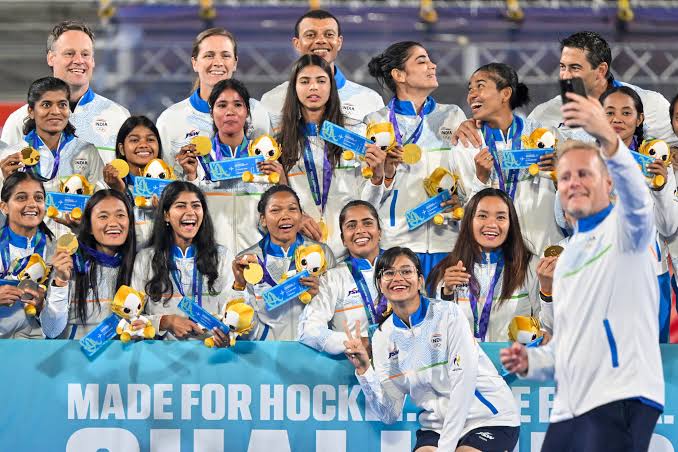
India emerged gold in both men’s and women’s hockey Men’s team defeated Malaysia 5-1 in the final and also earned a qualification for the 2028 Los Angeles Games through the Asian Games gold.
In cricket, also bringing India another gold medal, the men’s team beat Pakistan in the T20 final. India held on to the men’s Asian Games cricket title.
Golf created yet another history as Pranavi Urs carved her name into the record books by clinching individual Asian Games gold for India.
Athletics Remains A Mixed Story
Athletics earned a total of 24 medals, more than any other Indian sport at these Games.
Yet the gold medal count was limited.
That creates an interesting contradiction.
India is fielding more medal-capable athletes, but winning gold has become a challenge in a few individual disciplines.
Gulveer Singh was one of the standouts, taking away three medals from the Games. The efforts suggest that India is showing an improvement in its depth in the sport but also stress on the importance of that depth translating into more medals of the golden variety.
Shooting Also Deserves A Closer Review
Shooting was still the top medal source, but reports are that India claimed fewer shooting medals than it did at Hangzhou.
This is also noteworthy as shooting has been one of India’s strongest Olympic and Asian Games sports in recent years.
The big gain for the Indian campaign was the debut of Neeru Dhanda, who emerged with a women’s trap gold, despite not being on the core TOPS list which formed the basis of a recent Indian Express analysis.
Her success has revived a familiar question:
Are the current athlete selection systems in India for athletes of elite status capturing all the right athletes in a timely manner?
The TOPS Question
The Target Olympic Podium Scheme, or TOPS, has emerged as one of the mainstays of India’s sports funding structure for the best athletes.
TOPS government spending has grown significantly in recent years.
An Indian Express examination after the Games revealed 97.84 crore was spent under TOPS during the build-up from the 2022 Asian Games to the latest edition.