For advertisement on our platform, do call at +91 6377460764 or email us at [email protected].
Kriti Sanon’s presence in a jewellery advertorial for Raksha Bandhan has sparked off a larger argument about women’s clothes, culture, and rights to self expression. Initially a comment on an ad campaign, the discussion escalated into a public clash between actor-politician Kangana Ranaut, followed by Congress leader and Lok Sabha Leader of Opposition Rahul Gandhi’s opinion on the matter.
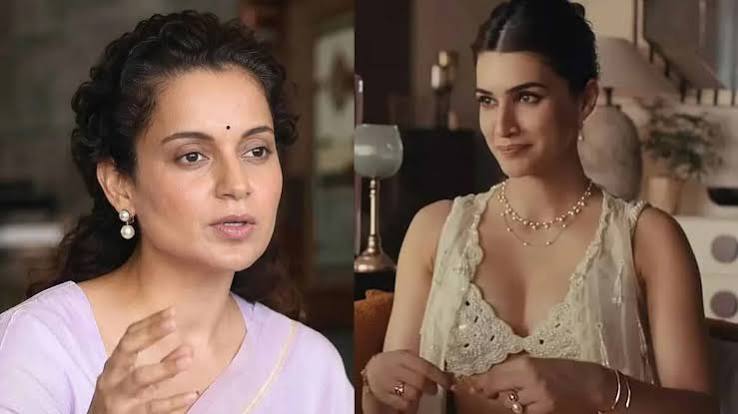
The ad showcases Kriti celebrating Raksha Bandhan in an ivory Ind-Western ensemble, comprising of a bralette-style top, a cape-like extension of the blouse, and a flowing, draped skirt. Kriti faced immense flak on social media, for an attire that many feel doesn’t gel well with the conventional theme of Raksha Bandhan.
Kangana Ranaut criticises the ad,
Among the first ones to slam the ad, Kangana had on her Instagram account questioned why a woman would choose such an attire for tying a Rakhi to her brother, and suggested that there were ample other outfits fit for the occasion.
She also went on to describe the ad as “creepy” and in doing so, injected a political and celebrity layer into what started as just another social-media commentary on an advertisement. She also objected to the ad where a Rakhi is being tied to a pet dog, bringing in two key discussions concerning women’s clothing and the portrayal of tradition in advertising.
Kriti Sanon gives a retort,
Answering the comments sans naming any particular person, Kriti expressed her thoughts on Instagram stories, where she reasoned that a festival’s essence shouldn’t be determined by a woman’s sartorial choice. According to her, “Festivals are about emotions and traditions.”
Kriti argued that culture “is a matter of the heart and not about a woman’s neckline” and also shared her interpretation of Raksha Bandhan, claiming that in her family, “it signifies a thread that binds two souls, to protect each other”. Kriti also cited an instance where she herself had tied a Rakhi to her sister, expressing belief that they can still protect each other, much like brothers.
Rahul Gandhi takes the matter further,
Just when it seemed that all that could be said about the advertisement had already been said, Rahul Gandhi weighed in on the controversy with a message supporting Kriti.
The Congress leader re-shared Kriti’s statement on Instagram and asserted that it is indeed a woman’s choice to wear what she pleases, do what she wants, and go where she chooses to. He also added that “it is disgraceful that women are often trolled for exercising this fundamental right.” Gandhi’s intervention took the controversy to a much higher level of discussion, changing the context from a celebrity ad campaign into a larger debate about women’s autonomy.
Debate of tradition versus freedom of expression,
The central contention in this controversy appears to be the conflict between cultural expectations and the freedom of personal choice. Those opposing Kriti suggest that an advertisement that relies on traditional motifs for its backdrop should also consider cultural context and adhere to convention. This perspective maintains that advertisements shape public perception, thus influencing the notion of tradition.
On the other hand, Kriti has emphasized that her religious belief cannot be weighed against her attire, “Culture is in the heart. Festivals are made up of relationships and emotions. One’s belief or tradition is not bound to the number of clothes a woman chooses to wear.”
This statement implies that the spirit of Raksha Bandhan, or indeed any other festival, shouldn’t be reduced to mere clothing.
The disagreement raises yet another significant question: where does cultural constraint end and personal liberty begin?
Questions surrounding women’s outfits,
As is often the case when discussing female celebrities and fashion, this particular controversy too opens up the broader debate that periodically flares up in public discourse. Female public figures are often subject to judgement on grounds other than just what they say or do; their clothes being one of the most apparent means of judgment. Modern and revealing outfits can face criticism even when the context has nothing to do with the morals, while traditional wear often receives endorsement as being “culturally relevant.”
Kriti’s comment to this effect was directly targeted at shaming women for their outfits, and she stood firm that respect for culture cannot be determined by a woman’s attire. Similarly, Rahul Gandhi’s intervention clearly highlighted the aspect of personal choice in what a woman decides to wear.
Kriti’s sister also chips in,
Adding to Kriti’s stance was the support she got from her sister, Nupur Sanon. Nupur shared a personal tweet responding to the outrage by clarifying that it was she whom Kriti was tying the Rakhi to during their familial Raksha Bandhan celebration, and asked who the outsiders were to question how they were observing their traditions.
Her intervention added a dimension of personal feeling and family importance to the discussion surrounding the Rakhi ad.
Why the ad became controversial,
In the realm of celebrity advertising, an advertisement has to strike a delicate balance between the personas of the celebrity and the image of the product/idea. However, here, that balance between the personal (Kriti as a person) and the public (Kriti as an influencer) was compromised. An advertisement for Raksha Bandhan is centered on the essence and traditions of a significant festival, and the modern style of attire can strike discordant notes. It demonstrated how a popular festival could evoke sensitivities that are readily triggered, especially in the age of social media.
The end of this debate is yet unknown,
The Raksha Bandhan advertisement involving Kriti is no longer just a dispute over a piece of clothing; instead, it has become a nexus of Bollywood, political discourse, the ever-evolving fashion scene and of course, women’s autonomy. Kangana’s accusations, Kriti’s defense and Rahul Gandhi’s statements have polarized opinions between proponents of artistic liberation who embrace the modern rendition of a traditionally Indian festival, and those who argue that the styling is ill-suited for the cultural underpinnings of Raksha Bandhan. The controversy centers not only on the particular garment, but on the question of who has the authority to define what is culturally appropriate.
Keywords
Kriti Sanon, Kangana Ranaut, Rahul Gandhi, Raksha Bandhan advertisement, Rakhi ad controversy, women’s clothing, women’s choice, Bollywood controversy, Indian culture, celebrity controversy, fashion debate