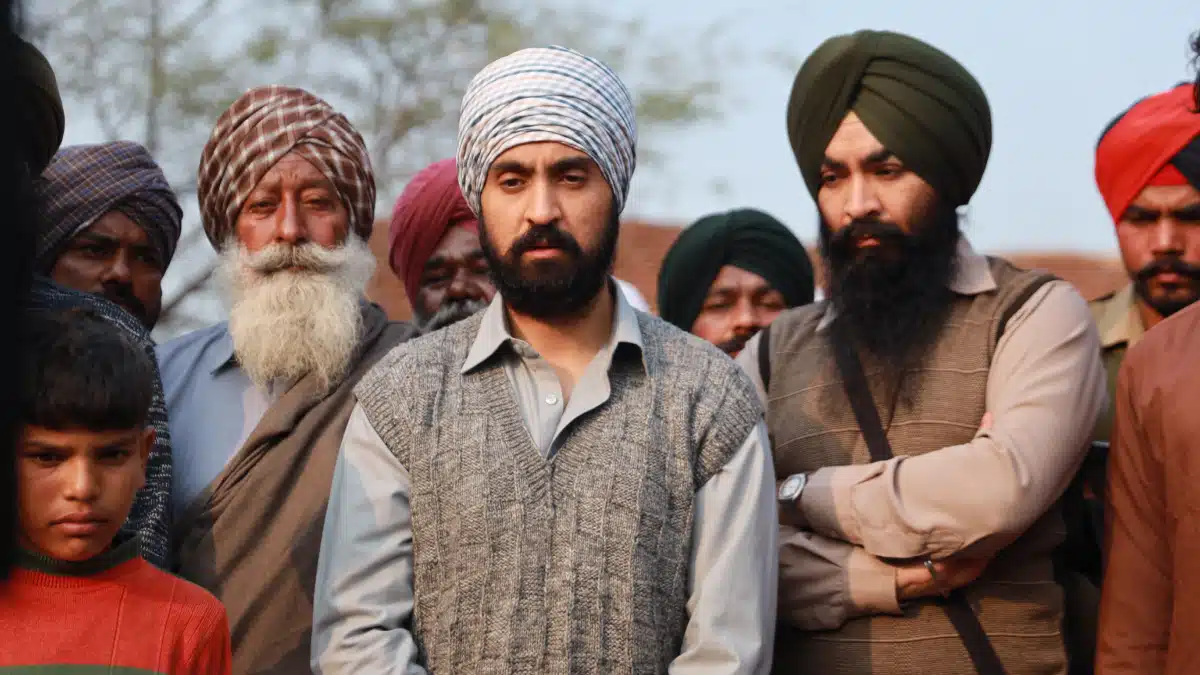
A huge controversy is going on in India, which has gone viral, over the banning of the film Sutluj
https://en.wikipedia.org/wiki/Satluj_(film)
For advertisement on our platform, do call at +91 6377460764 or email us at [email protected].
The film is based on the life and work of the banker turned human rights activist Jaswant Singh Khalra.
https://en.wikipedia.org/wiki/Jaswant_Singh_Khalra
It was produced both in Hindi and Punjabi. It was scheduled to be released in 2023, but several objections to it were raised by the Indian Central Board of Film Certification ( CBFC ), the statutory film certification body in the Ministry of Information and Broadcasting, Government of India, without whose certificate a film cannot be released. The CBFC demanded 127 cuts in the film, but it was digitally released without these cuts by Zee5 on 3.7.2026. However, 2 days thereafter it was taken off by Zee5.
The film has never been shown in Indian cinema halls, though it has been released abroad in several countries e.g. America.
Should the ban have been imposed in India ? This question requires careful consideration.
While there is freedom of speech guaranteed by Article 19(1)(a) of the Indian Constitution, this right is not absolute, but can be restricted vide Article 19(2) which states :
” Nothing in sub-clause (a) of clause (1) shall affect the operation of any existing law, or prevent the State from making any law, in so far as such law imposes reasonable restrictions on the exercise of the right conferred by the said sub-clause in the interests of the sovereignty and integrity of India, the security of the State, friendly relations with Foreign States, public order, decency or morality or in relation to contempt of court, defamation or incitement to an offence ”.
The Indian government opposed and blocked the release of the film because a government committee determined its narrative was unbalanced, stating it “whitewashed the acts of the militants” while highlighting police excesses. The committee raised national security concerns, claiming the film could endanger public order and be misused by anti-India elements.
My own opinion is this : it is true that in combating Sikh militancy in the 1980s and early 1990s the Punjab police committed many excesses, highlighted by Jaswant Singh Khalra, who had personally investigated 3 crematorium grounds and morgues in Punjab, and found thousands ( which could be upto 25,000 ) of dead bodies there of Sikh youths apparently killed in fake encounters by the Punjab police, allegedly on the orders of Punjab Director General of Police K.P.S.Gill. Many such youth were in fact not militants, but had been killed on mere suspicion of being so.
Khalra was a brave man, and presented facts truthfully. He is the main protagonist in the film Sutluj, which rightly portrays him as a courageous investigator, determined to unearth the truth, for which he paid with his life.
The objection to the film, however, is that it is one-sided, and presents only one side of the picture. A half truth is sometimes as dangerous as a total lie.
The other side of the picture is that at the time of the militancy many innocent Hindus, and many innocent Punjab police officers and men, were also killed in cold blood by the Sikh militants. Sometimes buses and trains in Punjab were stopped by these militants, who told the Hindu passengers to get off, and selectively shot them with AK-47 rifles.
During the peak of the Khalistan movement in the 1980s and 1990s, Sikh militants, engaged in an insurgency to create an independent state, created a reign of terror, during which thousands of innocent Hindus were killed. Militant groups frequently targeted Hindu civilians and businessmen in public spaces, on passenger trains, and in their homes to ignite communal tensions and drive the Hindu population out of Punjab.
Prominent, documented attacks on Hindu civilians during this period include:
1987 Lalru and Fatehabad Bus Massacres: In July 1987, militants stopped buses near Lalru in Haryana and Fatehabad in Punjab, segregating and executing Hindu passengers, resulting in the deaths of over 70 individuals.
1991 Ludhiana Train Killings: In December 1991, militants boarded a passenger train in Ludhiana and shot passengers, killing approximately 49 people, nearly all of whom were Hindus.
1990 Abohar Market Shooting: In March 1990, Sikh gunmen opened fire on a market in the predominantly Hindu town of Abohar, killing roughly 22 people.
1989 Moga Park Shooting: In June 1989, suspected militants killed at least 24 people exercising in a public park in Moga
Mediapersons who spoke out were not spared. The most notable killings of Hindu editors by Sikh militants occurred in Punjab during the 1980s Khalistan insurgency. Lala Jagat Narain, the founder of the Hind Samachar newspaper group, was assassinated in September 1981, and his son, Romesh Chander, was murdered in May 1984 for their vocal opposition to Sikh extremism.
Several police officers and men ( including Sikhs ) who were opposed to the militancy were also killed.
I am not mentioning all this to justify the numerous excesses committed by the Punjab police under K.P.S.Gill. Fake encounters and extra judicial killings are totally illegal and violative of Article 21 of the Indian Constitution, which says that no one can be deprived of his life or liberty except in accordance with the procedure established by law. Kalra, who was only investigating facts, was abducted by some Punjab policemen, tortured, and then murdered by them in cold blood.
I gave a judgment in the Supreme Court that policemen who commit fake encounters should be given death sentence
https://indiankanoon.org/doc/1979158
I have also written an article on fake encounters
https://m.thewire.in/article/government/hyderabad-police-encounter
In a petition filed by Paramjit Kaur, widow of Jaswant Singh Khalra, the Indian Supreme Court ordered a CBI probe into the death of Khalra
https://indiankanoon.org/doc/1538237
In this judgment the Supreme Court observed :
” This Court cannot close its eyes to the contents of the Press Note dated January 16, 1995 stated to be investigated by Khalra and Dhillon. In case it is found that the facts stated in the Press Note are correct – even partially – it would be a gorytale of human rights violations. It is horrifying to visualize that dead-bodies of large number of persons – allegedly thousands – could be cremated by the police unceremoniously with a label “
Thereafter, in 2011, the Supreme Court of India upheld the life imprisonment of five Punjab Police officers for the 1995 abduction, torture, and murder of human rights activist Jaswant Singh Khalra. The convicted officers were DSP Jaspal Singh and Sub-Inspectors Satnam Singh, Jasbir Singh, Surinderpal Singh, and Head Constable Prithipal Singh.
So what should be the conclusion of this discussion ? Should Sutluj have been banned or not ?
In my opinion the CBFC should have called the producer and director of the film, and should have patiently explained to them that while the Board is in favour of freedom of speech and expression, many people will perceive the film as one-sided. Having said that, the CBFC should have asked the producer and director to state the following at the beginning of the film :
” The producer and director of this film acknowledge that during the dark days of militancy in Punjab in the 1980s and early 1990s many innocent Sikhs, innocent Hindus, and innocent policemen were wrongfully killed by the militants. This film does not seek to absolve such killings, or hurt the feelings of the relatives and friends of those killed. It only depicts the killings of innocent Sikhs as found by the protagonist of the film, Jaswant Singh Khalra ”.
If the producer and director agreed to this condition, the CBFC should have certified the film for release.