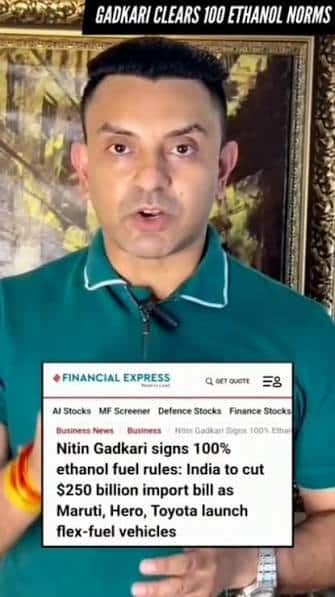
Though the government is touting the new signed agreement on E100 (100% ethanol) fuel regulations as a master stroke for reducing the country’s massive 22 trillion fossil fuel import bill and also benefiting the farming community, the reality for the average motorist on the street is starkly different. The new policy seems like an additional financial blow for a typical car owner.
For advertisement on our platform, do call at +91 6377460764 or email us at [email protected].
Here are the chief reasons behind the public outcry:
- Steep Decline in Mileage
Compared to pure petrol, ethanol has much lower energy density. For a flex-fuel car running on E100, there is a required increase in fuel consumption by 30 to 40 percent to achieve the same amount of power.
- So, if your existing car averages 20 kmpl on normal petrol, expect that to come down to 13-15 kmpl when running on E100.
- For E100 to be financially viable for the consumer, the price of ethanol fuel should be nearly half the cost of petrol (around 60-65 per litre). Unless the government introduces massive discounts or subsidies, a motorist will end up paying more money just for the same distance.
- Induced Obsolescence & Engine Damage
Pure ethanol is naturally corrosive and hygroscopic (absorbs moisture from the air). Millions of cars on Indian roads-including recently manufactured BS6 models already equipped for E20 fuel-are not designed to handle higher ethanol blends.
- The risk: Running E100 in a regular engine can cause accelerated wear and tear of seals, plastic components, fuel lines and vital engine parts.
- The financial burden: Although Nitin Gadkari had recently suggested that car manufacturers could potentially offer “upgrade kits” to make existing vehicles compatible with E100 fuel, the consumer is expected to pay for the retrofit out of his own pocket. A taxpayer who had recently purchased a car for lakhs feels that he is now being forced to destroy his engine, pay for an expensive modification, or buy a brand new flex-fuel vehicle.
- Allegations of Conflict of Interest
A major portion of the vitriol aimed at Nitin Gadkari-spread across social media and forums such as Reddit-is related to the optics. It is publicly known that Gadkari’s family has had a long history of involvement in the sugar and ethanol manufacturing businesses in Maharashtra (especially the Purti Group).
- Many taxpayers and critics are asking if there’s another motive at play besides the supposed benefits of higher ethanol usage. Most seem to believe that the public will be forced to sacrifice their cars and savings to ensure massive profit for the sugar and ethanol lobby, all while pretending to care about “green energy” and “self-reliance”.
The fact that the legal framework to pave the way for E100 was completed with a “single signed file” on a Friday evening left many feeling that a huge decision with massive market implications was shoved down their throats without proper democratic deliberation.
- Lack of Infrastructure & Transparency
- There is currently no widespread infrastructure for the proper storage and distribution of E100 which necessitates dedicated tanks to prevent moisture absorption.
- Car owners are panicking about the future resale value of their existing petrol cars and whether standard, lower-blend petrol will still be accessible or affordable in the coming years as the country progresses with the ethanol push.
While E100 is seen as a macroeconomic advantage that supports farmers and reduces foreign oil dependence in the eyes of the government, for the taxpayer, it comes across as an autocratic mandate that devalues their current assets, increases their day-to-day expenses, and essentially pushes the entire financial burden of India’s transition to green energy on the middle class.