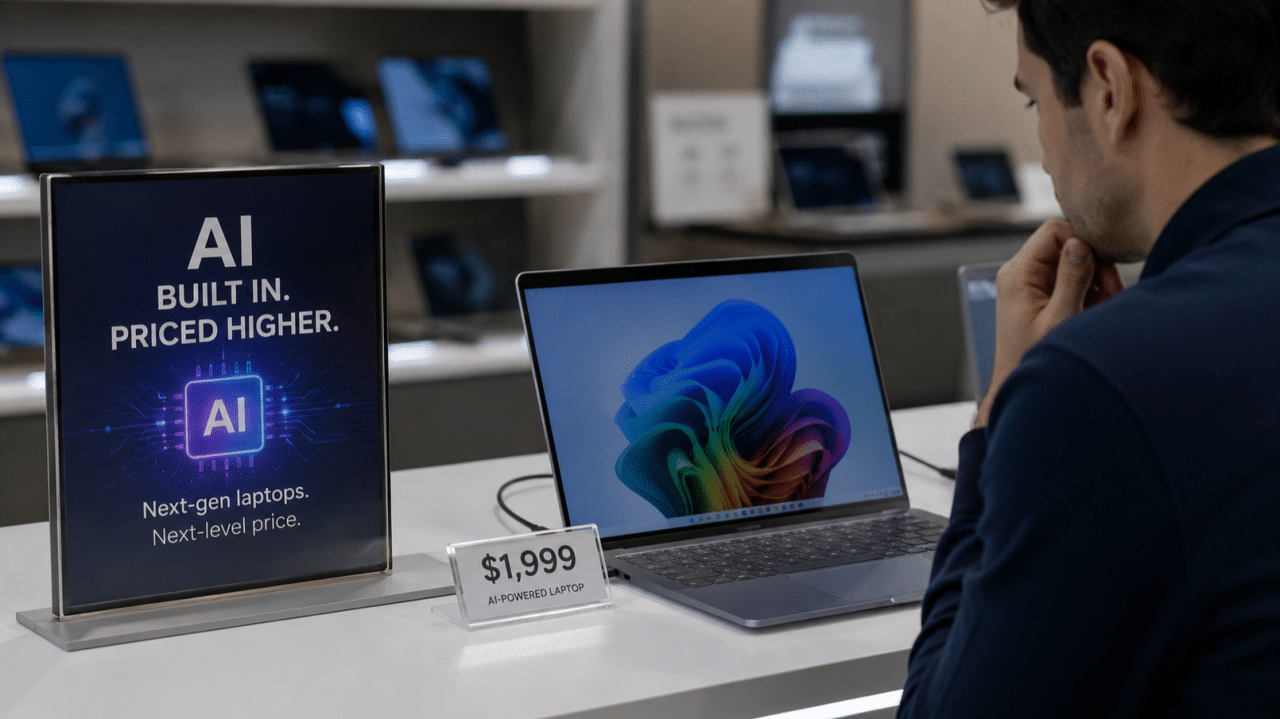
Since the new MacBook Pro lineup is expected to be even more expensive than the current model, why would the price of the laptop increase even if nothing major changes?
For advertisement on our platform, do call at +91 6377460764 or email us at [email protected].
The purchase of a new laptop can cost more, and it might not be because of a more powerful chipset or high resolution screen or a longer battery life. Computer memory is an increasingly significant factor in the price consumers pay, but it’s not quite as visible.
The world’s tech industry continues to be thirsty for memory chips, especially as businesses continue to pour money into artificial intelligence, cloud computing and data centres. This demand is driving semiconductor manufacturers to adjust their production capacity and prioritize products.
The effects may be felt by the typical consumer. The laptop with the same specs as last year might be more expensive, and the change from 8GB to 16GB or 32GB RAM might be more costly.
This is especially important for Indian buyers, who also face import costs, exchange rates, taxes, and retail competition that all impact laptop prices.
While memory is not a major selling point for most laptops, it can play a big role in the model’s overall price and functionality.
What is RAM and Why Does All Laptop Computers Needs It?
The working memory of a computer in use, called Random Access Memory, is the memory used for temporary storage.
The laptop is able to keep the important things that are needed constantly close at hand when multiple programs are used, editing a document, watching a video meeting and more.
The more RAM that a computer has the more applications and larger workloads it can handle without having to call on slower storage.
The computers are commonly found with 8GB of RAM, although 16GB RAM is now a popular option among students, professionals and those who frequently work with multiple applications simultaneously. The higher the end system can be 32u, 64u or more.
The RAM is not a SSD that is used to store documents, photographs and installed applications. Both, however, require semiconductor memory technologies.
Most laptops employ DRAM, and most SSDs are made of NAND flash memory.
The cost of these parts may fluctuate, but both are affected by the manufacturing capacity, demand and supply across the world.
The importance and impact of Artificial Intelligence on the memory market.The significance and influence of Artificial Intelligence in the Memory Market.
The most significant advancement in the semiconductor industry has been the accelerated growth of AI infrastructure.The most notable trend in the semiconductor industry is the rapid expansion of AI infrastructure.
Data centres by AI firms and cloud service providers are constructing very massive data centres, which have strong processors, and a great deal more memory.
Large volumes of data need to be transferred quickly through advanced AI accelerators, which means the use of high-bandwidth memory or HBM.
Although it is not the same as traditional DRAM found on many laptops, HBM shares similar aspects of the semiconductor manufacturing business ecosystem.
The big memory manufacturers, including Samsung Electronics, SK hynix and Micron Technology, need to determine how they want to allocate the investment, manufacturing capacity and technology to various memory products.
As the demand for more expensive AI memory rises, manufacturers might be tempted to make more of that.
This limits the ability to increase conventional memory capacity, especially if it is already maximised in production.
The outcome doesn’t always mean there’s a current lack of laptop RAM. Rather, the manufacturers could end up in a tighter negotiating position when they negotiate for supplies and/or component costs.
The impact of higher memory prices on laptop manufacturers.The effect of the higher memory price on laptop manufacturers.
There are numerous parts of a laptop, such as the processor, display, battery, motherboard, storage and memory.
These are bought by manufacturers from suppliers and then added together to make complete products.
As memory prices climb, the production of a laptop can even become more expensive even if the company does not make a major redesign change to the laptop.
Sometimes large manufacturers use long term contracts, advance purchase and inventory management to protect themselves.
The arrangements can help to provide a lag effect that may help to smooth the impacts of price changes, but these arrangements cannot necessarily obviate the price changes themselves.
Unexpected component costs could pose a problem for smaller manufacturers and companies that have less purchasing power.
Laptop brands are then faced with a few choices. They can increase retail prices, accept lower profit margins, reduce promotional discounts or change the specifications offered at a particular price.
For instance, a manufacturer may offer a lower storage or RAM configuration on the same laptop, but sell it at the same price as before.
In other words, it is important for consumers to consider the price not only, but also, the configuration of what they are buying.
The reason you may be paying extra for the same laptop.Why the same laptop could cost more.
Consumers tend to expect that technologies will get less expensive as they go along.
In many, that’s a fair guessing job. The cost of older technology can be reduced because of manufacturing improvements, competition, and newer models.
The prices of semiconductors, however, are not always on a consistent decline.
There have been times in the past when there was too much of a good thing and there have been times when there was too little.
If manufacturers turn out more chips than there are customers to buy them, prices may drop dramatically. If demand is greater than supply, prices may increase.
Memory is a part of a computer that cannot be easily removed from the laptop.
RAM is the most important component in a modern laptop as it is used to run the operating system and applications.
However, the upward trend in memory pricing may make it difficult for manufacturers to cover the price without compromising on performance or profitability.
That’s why it is possible for a new laptop to be more expensive, even if its processor, display and design are basically the same.
Will 16GB Laptop, 32GB Laptop Cost More?
Memory inflation can be particularly pertinent for laptops with greater RAM memory.
The 16GB laptop will usually have more DRAM than a comparable 8GB laptop, and the 32GB laptop will need even more.