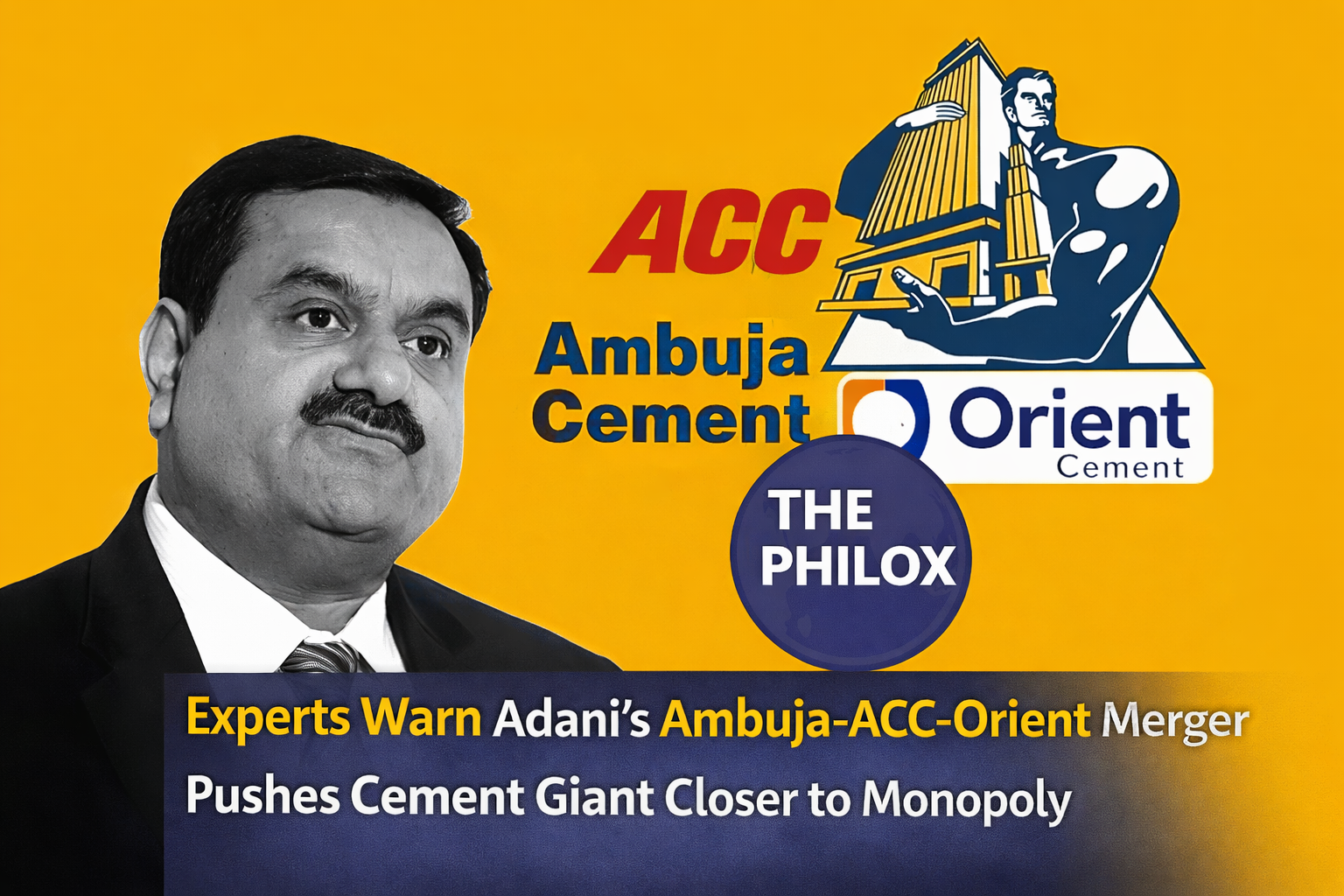
Monopoly fears are raised by Adani Cement Empire Consolidation.
The Indian cement business is experiencing a tectonic shift of huge proportions that has plunged market analysts and economic gurus into great concern. The Adani Group has officially unleashed a consolidation strategy on a large scale involving the three of its cement companies combing into a single giant. The board of directors at the Ambuja Cement signed a deal to merge the subsidiaries of the company into the parent company on Monday, ACC Limited and Orient Cement. This action will establish a single and unified cement giant with a pan-Indian presence and a potential massive market dominance. The conglomerate makes sense in terms of the business logic, but spectators caution that this puts the industry in a risky position of reaching a duopoly.
For advertisement on our platform, do call at +91 6377460764 or email us at [email protected].
This massive merger has once again brought about the issue of the increasing concentration of economic power in India. The acquisitions of ACC and the newly procured Orient Cement to form the Ambuja are consolidating operations of the Adani Group to compete with the market leader, UltraTech Cement. Analysts indicate that when two giant players have dominance in most of the supply, the consumer usually suffers. The fear is that when the number of competitors in the ring is low, the influence of determining prices of cement will be in very few hands. This merger means that internal competition among the brands of Adani is gone, and they can now speak with one voice.
The Mechanics of the Mega Merger.
The financial aspect of the merger indicates a well thought out process of fitting these companies together without the use of cash. Shareholders of ACC will be allowed to receive 328 shares of Ambuja Cements in lieu of 100 shares under the accepted plan. Equally, the shareholders of Orient Cement will receive 33 shares of Ambuja each of 100 shares they own. This share-swap arrangement guarantees the relocation of all the stakeholders to the Ambuja entity that will effectively delist ACC and Orient in the stock exchanges. The market response has been varied with shareholders of Orient enjoying a value whereas ACC investors have been cautious.
This re-organization of the corporation is not merely a matter of financial engineering but it is all about dominance on the ground. The resultant organisation will have an estimated production capacity of 155 million tonnes per annum by 2028. Adani hopes to save enormous sums of money by eliminating administrative redundancy of having three companies listed. According to the company, this simplification will enhance their margins by at least 100 per tonne of cement. However, critics say that such efficiencies to the company actually add up to market control and not reduced prices to the customers.
The Threat of a Two-Horse Race
The Indian cement market has been fragmented over decades with numerous regional firms making the market highly competitive in terms of pricing. The period seems to be dying down as the industry is fast becoming the race of two large corporations, between the Adani Group and the UltraTech of Aditya Birla Group. These two conglomerates are collectively buying in small players at a breakneck speed such that small companies cannot survive any longer in the middle range. They caution that this type of structure, which is a duopoly, is not good news to the construction and infrastructure industries. In duopoly, two leaders have no real reason to cut down on the prices and this form of collusion is referred to as tacit collusion by the economists.
This puzzle was an essential component and acquisition of Orient Cement provided Adani with better presence in the southern and western markets. Under this merger, the identities of these two companies will disappear and the consumers will have fewer options. One of the main concerns of the real estate developers is that the cement prices are already volatile and they may go permanently high. Small builders are working on small margins and they are not able to negotiate with giants as they would negotiate with others who are smaller in the region. The centralization of supply chains is that a decision taken in a single corporate boardroom will have an influence on the costs of construction in the entire country.
Regulatory Investigation and Political Condemnation.
The pace at which such purchases have been sanctioned has aroused the eyebrows of political opposition and governance watchdogs. The Orient Cement acquisition had already received the nod of Competition Commission of India (CCI) in March 2025. The critics such as the Congress party have accused the regulatory bodies of not curbing the establishment of the private monopolies. According to them, it is the duty of the government to see to it that key sectors such as infrastructure materials are competitive. Opposition leaders have also referred to this trend of unregulated corporate expansion as Monopoly Bachao Syndicate.
The politics of this particular merger notwithstanding, it appears to be a smooth sail because it is technically an internal restructuring. Because Adani already holds majority shares in all three companies, the merger is regarded as an intra group reorganization. Nevertheless, what it alludes to is that the control system in India might be too frail to curb oligopolies. According to legal experts, the existing competition laws are addressing individual transactions in lieu of the aggregate outcome of market dominance. With Adani and UltraTech acquiring the remaining independent companies and the companies, the regulator will be forced to interfere at some point.
Effects on Small Actors and Workforce.
This merger wave is posing an existential threat to the surviving small and medium sized cement companies. The firms with very shallow pockets, as Adani or Birla have, cannot compete with the logistics and energy efficiency of the giants. These smaller units become unprofitable and they will most probably be acquired or compelled to close down. The trend tends to result in retrenchments since the acquiring companies tend to retrench off the unnecessary employees in order to attain their synergy goals. The administrative positions will be cut in response to the overhead expenses by the merging of ACC and Orient into Ambuja.
In addition, the new unified structure is likely to subject the dealer and distribution networks to a lot of pressure. Earlier it could have been an advantage to a dealer to stock up various brands such as ACC, Ambuja and Orient individually. This time, they will have to contend with one monolith who is capable of prescribing terms, commissions and rights of territory. This change moves the control off local small businesses to the corporate headquarters.