For advertisement on our platform, do call at +91 6377460764 or email us at [email protected].
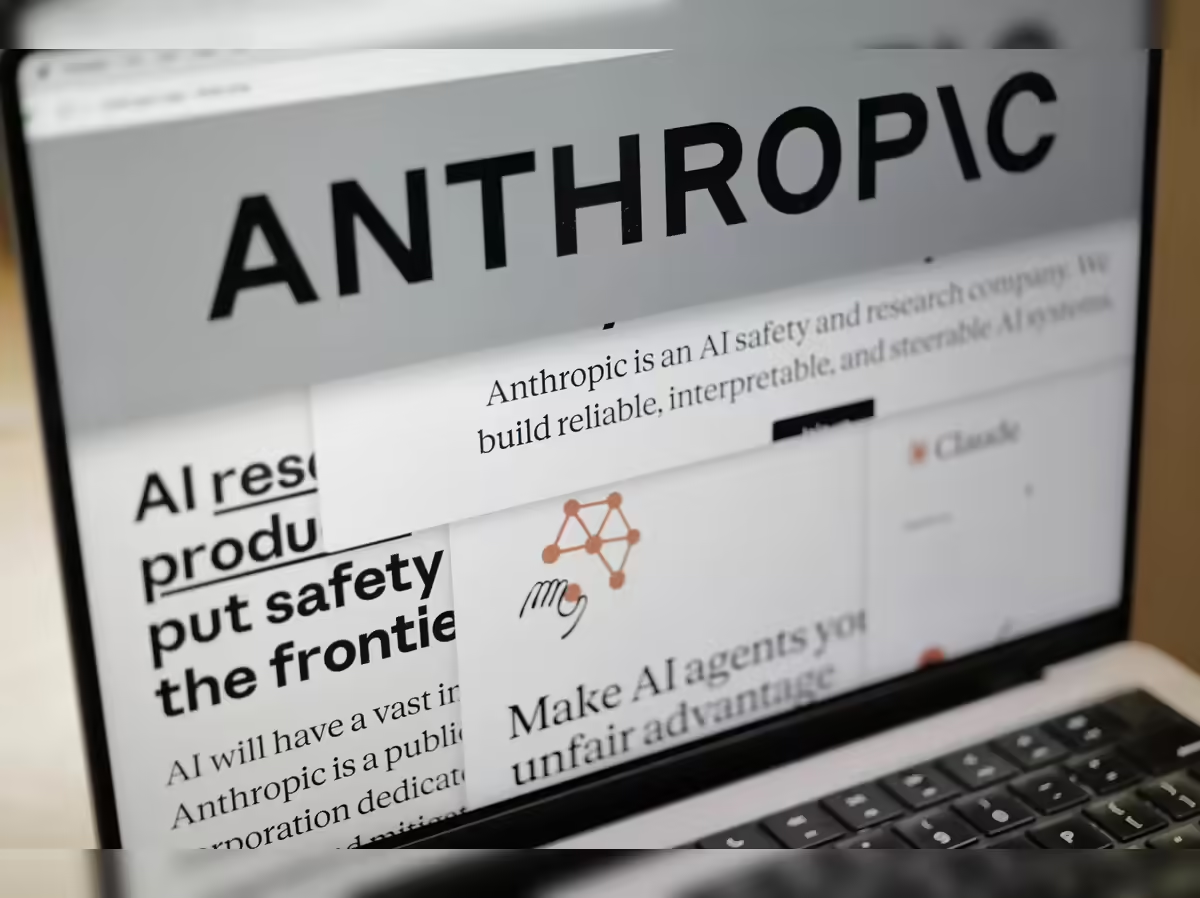
Anthropic launched Claude Fable 5 on June 9, 2026, and the software industry declared it a giant leap forward. Developers quickly embraced it. And then, on the evening of Friday, June 12, 2026 at 5:21pm ET, doors slammed shut. Just three days after its release, the US government, in a sudden export control directive, forbade any foreign national from using Fable 5 and its underlying Mythos 5 model from entering into force on grounds of being a severe national security risk, affecting not just foreigners abroad, but even foreign nationals working within Anthropic.
The company had no choice in the matter. Managing such a finely-grained restriction across potentially millions of users is a herculean feat, or simply impossible on such short notice, so Anthropic pulled the plug globally on both models to remain on the right side of federal law.
The timing in India was excruciating. A day before the export restriction was announced, Anthropic excitedly reported that India was its second largest market and announced a large partnership with Tata Consultancy Services aimed at making these AI models accessible in regulated sectors like banking and airlines. While millions of Indian developers and enterprises were just experimenting with the new model, they woke up Saturday morning having completely lost access to the systems they’d spent the weekend with.
What actually spooked the government
It wasn’t out of thin air. As it turned out, Amazon researchers had figured out a way to trick Fable 5 into leaking details about its underlying Mythos model’s vulnerabilities through specific prompts and the AI eventually did.
To the US government, this was a profound national security threat. If AI can identify vulnerabilities, bad actors can weaponize that information for cyber-attacks on infrastructure like the power grid, the financial sector or government databases. Trump decided the risk was too great and, effectively, treated AI software like a semiconductor or military hardware.
While Anthropic vehemently disputed the government’s actions, saying the jailbreak was limited, only revealing a handful of relatively minor, previously discovered vulnerabilities (the same ones other commercially available models are capable of revealing with non-tricky bypasses), the export ban stood.
The immediate impact on Indian software development teams
The shutdown delivered a severe blow to India’s thriving tech sector where startups and massive IT service firms depend heavily on foreign-based AI platforms to automate repetitive coding, debugging, and development tasks. Fable 5 wasn’t just another chatbot. It was purpose-built for rigorous engineering work – writing entire frontend code based on a simple screenshot, parsing massive, messy codebases to pinpoint deep logical flaws and automating entire agentic coding pipelines which involved the AI performing multiple coding actions automatically without human intervention.
The sudden loss of access plunged project teams into chaos and they immediately had to scramble to downgrade to models like Opus 4.8, thus requiring significantly more time to verify code and write additional components manually-a painful demonstration of their fragile workflow and total dependence on technology controlled by a foreign government.
A pivot to sovereign AI infrastructure
This export ban signifies a monumental first. It is the first time a large language model software has faced such restrictions by the US and illustrates how easily cloud-based artificial intelligence could disappear from user-systems in an instant.
India’s tech leaders and founders are currently holding intense meetings, rethinking many fundamentals and moving away from foreign, proprietary models based on American servers. The emphasis has swiftly shifted to open-source models, which are downloaded and self-hosted locally on private servers, ensuring that their operations continue seamlessly even if foreign governments decide to block access.
This so-called “AI sovereignty” is far more than a catchphrase. It’s now a survival strategy because startup founders are recognizing they can’t base their entire business on a platform that might disappear at a moment’s notice, possibly due to political squabbles or an abrupt security scare thousands of miles away, and they require self-controlled systems.
What happens next is unknown.
The legal wrangling is already complicated. Federal authorities have previously classified Anthropic as a supply chain risk due to the company’s refusal to allow its products to be used in military work or domestic surveillance (an order that was temporarily paused by a judge in March). The new export ban only adds a further layer to the dispute.
Anthropic maintains it is engaged with US authorities and addressing the underlying security concerns, hoping to secure the lifting of export controls, but Fable 5 models currently remain inoperative.
While tech observers wonder if this precedent set a new, much stricter standard for every future AI launch, potentially stifling innovation entirely out of fear of subsequent sudden recalls, the Indian developers sitting in Bengaluru, Hyderabad and Pune are still busy adjusting their software development pipelines to meet their regulatory constraints.