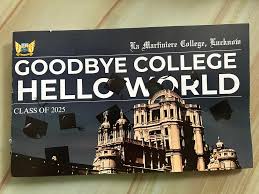
Founders Day of La Martiniere College, Lucknow
For advertisement on our platform, do call at +91 6377460764 or email us at [email protected].
By Justice Katju and Martinian Ali Sajid Husain
13th September 1800 is observed as Founder’s Day across 7 schools founded by Maj Gen Claude Martin – 2 in Lucknow, 2 in Kolkata and 3 in Lyons, France.
More than two centuries later, the presence of Claude Martin, a visionary behind a living legacy of education, architecture, and Lucknow’s syncretic culture, remains remarkably alive, in the magnificent buildings of Lucknow, in the educational institutions bearing his name, and in generations of young people who have carried his motto, Labore et Constantia (By Labour and Constancy) into the wider world.
Claude Martin was far more than a soldier, adventurer or wealthy European in eighteenth-century India. He was an ingenious, self-made and remarkably curious man who transformed the opportunities and adversities of his life into an enduring public legacy.
A Frenchman who made Lucknow his home, he was born in Lyon , France 1735 and came to India as a young man and embarked upon an extraordinary career. He served first as a soldier with the French, and subsequently the British East India Company, eventually rising to the rank of Major General. He spent the later and most productive part of his life in Lucknow, where he became a close friend of Nawab Asaf-ud-Daula.
It was in Lucknow that Martin’s many talents truly flourished. His arrival as representative of the British East India Company in the city coincided broadly with the transformation of Lucknow into the magnificent capital of Awadh under Nawab Asaf-ud-Daula. The Nawab’s patronage created an extraordinary environment in which Indian, Persian, European and other art, educational, and cultural features influenced one another.
Gen Claude Martin became an important participant in this cultural ferment. He was not merely an observer of Lucknow’s transformation. He helped shape it.
Martin possessed an unusual combination of talents. He was a soldier, surveyor, architect, engineer, entrepreneur, scientist, linguist, collector and bibliophile. The La Martinière tradition describes him as a self-taught man with interests ranging from architecture and surveying to botany, experimentation, finance and the arts.
His architectural imagination left an unmistakable imprint upon Lucknow. Among the buildings associated with him are Constantia, Farhat Baksh, the present Raj Bhavan, Bibiapur Kothi and other structures, while his architectural influence extended into the wider development of the city.
His greatest architectural creation was undoubtedly Constantia—the extraordinary palace that was to become La Martinière College. Constantia itself is a remarkable expression of the world Martin inhabited, European architectural ideas adapted to an Indian environment, incorporating local craftsmanship, materials and artistic traditions. In that sense, Constantia is more than a building. It is a stone-and-brick metaphor for Claude Martin’s life: East and West meeting and supplementing each other, without either erasing the other.
Martin’s relationship with Nawab Asaf-ud-Daula was particularly significant. The Nawab was himself a great patron of architecture, arts and culture and Martin became a trusted associate, adviser and financial intermediary at the Awadh court. Contemporary and later accounts portray him as someone able to navigate the worlds of the Nawab and the East India Company with remarkable skill. The relationship between Asaf-ud-Daula and Martin therefore represents something larger than the story of an individual European in India. Together with many other Indians, Persians, Europeans and others who converged upon eighteenth-century Lucknow, they participated in the creation of the city’s extraordinary syncretic culture, characterised by finesse, accommodation, refinement and creative, a culture that had deep Indian, Persian and regional roots. But it is reasonable to regard him as one of the important European participants in the cultural synthesis that made Nawabi Lucknow distinctive.
The most remarkable chapter of Martin’s story, however, began with his death. Martin died in Lucknow on 13 September 1800. He had accumulated an immense fortune, but he never married, and had no heirs to whom he could leave it. But he made an extraordinary will, leaving a fortune for setting up educational institutions, like charitable trusts created by Ford, Rockefeller, Bill Gates, and Warren Buffett
In his will, he made extensive charitable and educational provisions. Most importantly, he directed that his estate should help establish educational institutions in Lucknow, Calcutta (Kolkata) and Lyon, his birthplace in France.
This is where Martin’s story transcends that of a wealthy eighteenth-century adventurer, and transcends him to a philanthropist. He converted his private fortune into a public inheritance, and he did so through education.
The schools he visualized were eventually established after prolonged legal proceedings surrounding his will. La Martinière Kolkata opened in 1836, while La Martinière College Lucknow was established in 1845; institutions were also established in Lyon, in city where he was born.
The vision was remarkable for its time: knowledge should become a means of enabling young people to make something of their lives.
The legacy was therefore not simply financial. It was generational.
More than two centuries after Martin wrote his will, the true measure of his foresight is not the size of his fortune or even the magnificence of Constantia. It is the people who passed through the institutions he endowed.The La Martinière family of schools has produced people who have made their mark in armed forces, administration science, scholarship, cinema, journalism, sport, public life.
Prominent alumni of La Martiniere College, Lucknow are, K. Raghunath, former Foreign Secretary, Government of India, Muzaffar Ali, film producer and director, Saeed Naqvi, Vinod Mehta, Chandan Mitra, and Siddhartha Varadarajan, journalists, Ali Khan Mehmudabad, Professor, Ashoka University, Indian Air Force decorated pilots Denzil and Trevor Keeler, actress Priyanka Chopra, among others.
Martin’s educational legacy has repeatedly produced individuals capable of finding their own paths and contributing to society in very different fields. That is precisely what makes his educational vision so enduring. A self-taught man who understood the power of education
There is an especially beautiful irony in Martin’s story. He was largely self-educated. He knew from personal experience how difficult it could be to acquire knowledge without easy access to formal education. His own intellectual curiosity drove him to build a substantial library, pursue languages, study science and experiment with new technologies. His Lucknow residence became a centre of intellectual and artistic activity. Consequently, when he thought about what should survive him, he did not choose merely to leave behind a palace. He chose to leave behind institutions capable of educating the young.
Constantia was therefore transformed from a personal residence into a centre of learning. And the man who had spent his life acquiring knowledge for himself ultimately sought to make knowledge accessible to generations who would come after him.
His greatest monument is not Constantia. Constantia is undoubtedly Claude Martin’s most visible monument. But his greatest monument is human.
Buildings weather, fortunes disappear, armies and empires pass. But an educated mind can influence another mind, which influences another—and thereby carry an idea across centuries.
That is what Martin achieved. His legacy travelled from Lyon to India, from Kolkata to Lucknow, from the eighteenth century into the twenty-first, and from one generation of students to another.
There is another dimension to Martin’s legacy that feels particularly relevant today. Claude Martin was a global citizen. He was born French, he lived and prospered in India, he served both French and British interests, he became deeply embedded in Awadhi society, he collected books and knowledge from different cultures, and ultimately he divided his educational legacy between England, France and India.
In an age increasingly conscious of the interconnectedness of humanity, Claude Martin can therefore be remembered as an early example of a citizen of multiple worlds. His life reminds us that cultural identity need not be a wall, but can be a bridge.
Remembering the Founder
Every year, on 13 September, Martinians across the world remember Claude Martin on Founder’s Day—the anniversary of his death.
But perhaps the most meaningful way to remember him is not merely to celebrate the man who founded La Martinière. It is to understand the principle behind his bequest.
Claude Martin accumulated wealth through an extraordinary life. He chose to turn that wealth into opportunity. He built palaces, but he also built institutions. He mastered languages, but he ultimately invested in the language of education. He crossed geographical and cultural boundaries during his lifetime, and his legacy continued crossing them after his death.
And in Lucknow, the city that became his chosen home, he became part of a remarkable cultural moment in which diverse traditions met, mingled and created something new
Perhaps the finest tribute to Claude Martin is therefore this: he came to India seeking his fortune, but he left behind something far more valuable—a fortune converted into knowledge, knowledge converted into character, and character carried forward by generations. His buildings remain landmarks of Lucknow. His schools remain nurseries of talent. His motto remains a philosophy of life : LABORE ET CONSTANTIA ( By Labour and Constancy ).
And perhaps that is why, 226 years after his death on 13 September 1800, Claude Martin is still remembered—not simply as the Founder, but as a man whose life became a bridge between cultures and whose fortune became an investment in the future of humanity.
His palaces were built in stone.
His schools were built in knowledge.
But his most enduring monument is the human potential he helped set free.
To conclude, a reply is called for to those who say that English medium educational institutions in India, like La Martiniere College, were made by our British rulers, and serve only the elite in society, and hence should be abolished.
My reply is that the national interest requires that the level of vernacular schools should be raised to that of these English medium schools, and not that the level of English medium schools should be brought down to the level of the former.
In this connection it is interesting, and even somewhat amusing, to note that those politicians who are most vociferous against English, put their children in English medium schools, e.g. Mulayam Singh Yadav, who sent his son Akhilesh to Australia to study.
Obviously, such people know that English medium education opens many more doors for the future of their wards than vernacular school education.