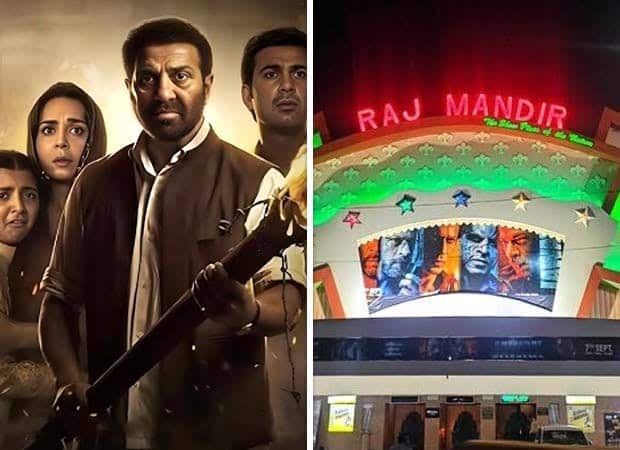
A Lucky Screen in the Pink City
Sunny Deol is taking his next big swing away from the usual Mumbai studio setups. Instead of holding a standard press conference at a five-star hotel in Juhu, the actor and his production team are kicking off the campaign for Batwara 1947 in Rajasthan. The official trailer launch happens on Tuesday, July 28, inside the Raj Mandir Cinema in Jaipur.
For advertisement on our platform, do call at +91 6377460764 or email us at [email protected].
Anyone who tracks the movie business knows this venue.
It opened back in the mid-1970s and looks like a giant pink meringue from the outside. Inside, it is all velvet curtains, chandeliers, and high ceilings that make modern multiplexes look like airport waiting rooms.
The choice was not random. Film promotions have changed a lot over the last few years, and actors are realizing that single-screen theaters in Tier-2 cities generate way more organic noise than a room full of Mumbai paparazzi. Hundreds of local fans and regional media reporters have been invited to fill the seats for the screening.
The producers wanted a loud, crowded hall where you can actually hear people whistle and cheer when the dialogue hits the screen.
Raj Mandir holds over eleven hundred people at once. When that room gets noisy, the sound carries outside to the street.
Why This Theatre Matters to Deol
There is a very specific reason why Deol insisted on starting the Batwara 1947 promotional train at this exact address. Superstars are superstitious people. For Deol, Raj Mandir has turned into a proven lucky charm over the past few box office cycles.
Back in 2023, before Gadar 2 went on to shatter ticket records across northern India, he visited this same theatre to promote the re-release of the original 2001 film Gadar: Ek Prem Katha. The crowd response that afternoon caught the trade experts off guard. Thousands of people blocked the roads outside the hall just to get a glimpse of him.
That Jaipur trip set the tone for the entire marketing campaign of Gadar 2, turning it into a massive hit that made over five hundred crores.
He went back to Raj Mandir again in 2025 during the buildup for Jaat, which also turned into a solid money-maker at the ticket windows.
When the planning meetings for Batwara 1947 started at Aamir Khan Productions, the distribution team looked at the calendar and the map. Deol made it clear that the first public screening of the footage had to happen on that specific screen in Jaipur. The theater management already knows how to handle his fan clubs, having dealt with the security headaches twice in recent years. They have the extra barricades ready.
A Double Launch Strategy
Aamir Khan is backing this project as the producer, and his team designed a two-city promotional sprint. The Jaipur event on July 28 is built purely for mass energy and crowd reactions. Once the fans get their first look at the footage, the entire cast and crew will board a flight back to Maharashtra.
The next day, July 29, they will host a second, more formal launch event in Mumbai. That follow-up session is geared toward national trade journalists, critics, and industry insiders who dissect box office projections and screen allocations. Splitting the launch across two consecutive days keeps the film in the news cycle for forty-eight hours straight instead of burning all the excitement in a single afternoon.
Both Aamir Khan and director Rajkumar Santoshi will sit alongside Deol for both events.
It is a smart way to cover all bases. The Jaipur event gives them viral social media clips of real crowds shouting in a single-screen hall. The Mumbai event gives them the analytical print headlines and television interviews needed to reach urban multiplex audiences.
The Team Behind the Period Drama
This movie brings back a director-actor partnership that generated some of the hardest-hitting drama films of the 1990s. Rajkumar Santoshi directed Deol in Ghayal, Damini, and Ghatak. Those movies built Deol’s reputation as the guy who fights corruption and injustice with heavy dialogues and physical action.
They have not worked together on a scale like this in decades.
Adding Aamir Khan as the creative producer makes the setup even more interesting for trade analysts. Khan is known for micro-managing script details and post-production, while Santoshi prefers old-school, theatrical storytelling with high emotional stakes.
The supporting cast brings together names from different corners of the industry. Preity Zinta returns to the big screen after a long break to play Deol’s wife. Veteran actress Shabana Azmi handles a central role that drives the entire conflict of the script.
Ali Fazal, Abhimanyu Singh, and Deol’s own son, Karan Deol, also share screen time in the ensemble setup.
A.R.
Rahman composed the background score and soundtrack, working with lyricist Javed Akhtar to match the 1940s setting.
What the Story Brings to Theatres
The script is an adaptation of a famous play called Jis Lahore Nai Dekhya, written by Syed Asghar Wajahat. The plot drops the audience directly into the chaos of the 1947 Partition. Deol plays the head of a Muslim family that leaves India and gets allotted a large haveli in Lahore after reaching Pakistan.
The twist happens when they unlock the front door.
An elderly Hindu woman, played by Azmi, is still living upstairs and refuses to abandon her ancestral home.
Instead of turning into a standard property dispute, the story shifts into a drama about community pressure and protection. Local politicians and angry mobs try to force the old woman out onto the streets. Deol’s character decides to stand in front of her like a wall, defending her right to stay in the house despite the religious divide and the riots happening outside.
The Central Board of Film Certification reviewed the final edit last week.
They passed the film without ordering a single audio or visual cut, handing it an ‘A’ certificate due to the intensity of the riot violence. The theatrical release is booked nationwide for August 14, lining up directly with Partition Remembrance Day.