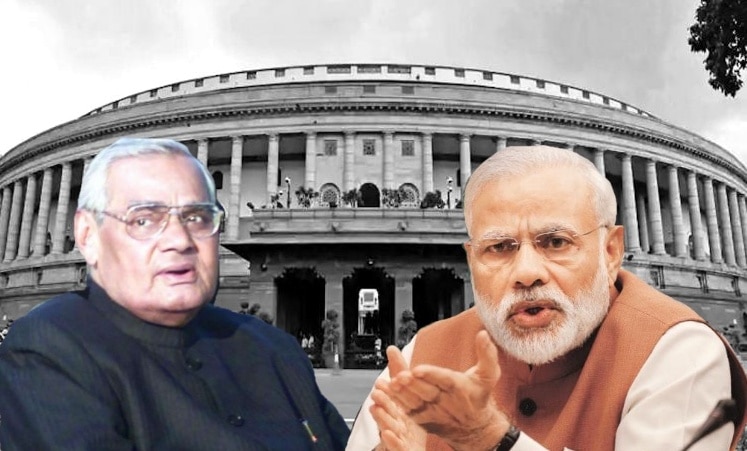
The Dark Side of Raja Dharma and Democracy.
Political analysts and historians are often rekindling the era of former Prime Minister Atal Bihari Vajpayee, in the attempt to make sharp comparisons between the current administration under Prime Minister Narendra Modi. One of the points of such comparison is the idea of “Raj Dharma,” something famously stated by Vajpayee in 2002 when he advised the then-Chief Minister Modi to adhere to the duty of the ruler without distinction. According to critics and his former peers, the beliefs of Vajpayee that parliamentary procedure needs to be followed and the belief in institutional autonomy is the stark contrast to the perceived destruction of democratic norms in these days. It has been observed that whereas Vajpayee was heading a loose coalition that needed constant consensus-building, the current government, which is backed by majority in one party, is accused of circumventing the legislative process and the opposition.
For advertisement on our platform, do call at +91 6377460764 or email us at [email protected].
It is observed by many political scientists that Vajpayee did not see the opposition as enemies but rather, it was necessary to have adversaries in a democratic arrangement. The move to send Rajiv Gandhi, who was at that time an opposition leader, to represent India at the UN, is cited by historians as an indication of his bipartisan approach. Conversely, the opposition leaders nowadays are accusing the current administration of treating dissent as being anti-national especially as international democracy watch dogs concurred. Such organizations have lowered the rankings of India based on a fall in civil liberties and press freedom. According to analysts, Vajpayee who served as a parliamentarian over decades would be deeply worried about the disruptions and absence of debate that is common in the present Lok Sabha.
Parliamentary Procedures and Concentration of Power.
Much of the criticism of the democratic norms is concerned with the way Parliament operates. Experts of legislation point out that during Vajpayee, legislative bills were hardly approved without important debates or age-old committee reference. According to the data provided by parliamentary research groups, the number of bills submitted to committees to be scrutinized by them is drastically reducing during the Modi government. This has led to a criticism that this has diluted the deliberative nature of democracy that Vajpayee promoted because of the rush to make laws usually in the middle of opposition protests or suspensions. According to former cabinet ministers during the Vajpayee era, he cared more about the so-called Coalition Dharma, where even the minor allies felt listened to and argue that this is lacking in the current centralized form of governance.
Another sphere where parallels can be easily made is the centralization of power in the office of the Prime Minister (PMO). According to the bureaucrats who had worked in the earlier regimes, the style of Vajpayee was that of delegation, wherein the ministers had wide scope of autonomy in their respective areas. It has been reported that the current administration is working under a very centralized model where major decisions are made directly by the PMO without necessarily following the traditional method of making decisions through the cabinet. The political commentators claim that this has undermined collective accountability of the cabinet which was a fundamental principle of the Westminster system which was strictly followed by Vajpayee in his tenure as a prime minister.
Expanding Economic Inequality disparities and Unemployment Development.
Although the Vajpayee government is accredited to have started major economic reforms such as privatization and development of infrastructures, economic analysts attribute a changed orientation as far as inequality is concerned. Economists notice that even though the campaign of 2004, called India Shining was unsuccessful due to its lack of appeal to the rural poor, the structural disparity today is arguably even bigger. According to the recent reports by global inequality labs, the gap between the ultra-rich and the working one has increased significantly within the past decade. According to critics, although the policies made by Vajpayee were geared towards liberalization, an effort was made to offset it with rural connectivity initiatives such as the Pradhan Mantri Gram Sadak Yojana (PMGSY).
It is common to find the opposition parties pointing out how the economic growth currently being experienced is being accomplished at the cost of the informal sector since it is a K-shaped recovery where the organized segment of the economy is performing well. According to labor economists, stagnant real wages and high unemployment among youths are good signs that the fruits of growth are failing to trickle down. According to them, the government of Vajpayee, although pro-business, was still attuned to the agrarian crisis which later cost them the 2004 election. In contrast, the present regime has been accused of favoring a few corporate conglomerates, a claim confirmed by some financial experts who monitor market concentration in some of the major sectors of the economy such as ports and telecom.
Freedom of Press and Institutional Freedom.
Perhaps the most controversial fact of comparison between the two eras is the state of the media and independent institutions. The veteran journalists who had earlier reported the Prime Ministers Office in late 1990s remember a relationship that was characterized by respect and openness to all. They observe that Vajpayee habitually conducted press conferences and even permitted himself to be interrogated by the critical journalists. Conversely, media critics note that Prime Minister Modi has never conducted a press conference in the ten years of his rule. This absence of personal responsibility combined with the accusations of forcing the media houses to fit into a pro-government narrative is a great departure of the standards during the Vajpayee era.
Moreover, the issue of independence of investigative agencies has become the most controversial. The leaders of the opposition claim that various services such as the Enforcement Directorate (ED) and the Central Bureau of Investigation (CBI) are being used to attack political opponents. Although such references to the abuse of power were made in earlier times, legal analysts believe that the rate and the rate of taking action against opposition individuals today is unprecedented. They imply that Vajpayee, who has had a strong opposition and a watchful judiciary, has been working on an institutional checks and balances system which seems to be withering in the current day world. Others, including former members of the same party of Vajpayee, who have now turned into his critics, were the ones who argue that he would have been quite displeased when using his state machinery to score points.
Old Guard and Ideological Shifts.
The worst accusations are by fellow colleagues of Vajpayee who claim that the ideological backbone of the party has changed. Other leaders such as Yashwant Sinha and Arun Shourie who served as key figures in the Vajpayee cabinet have come out strongly to express their displeasure with the way things are going. They argue that the BJP of Vajpayee was a right of center party, that tried to accommodate various opinions, but the present one is of a more hardline and majoritarian nature.