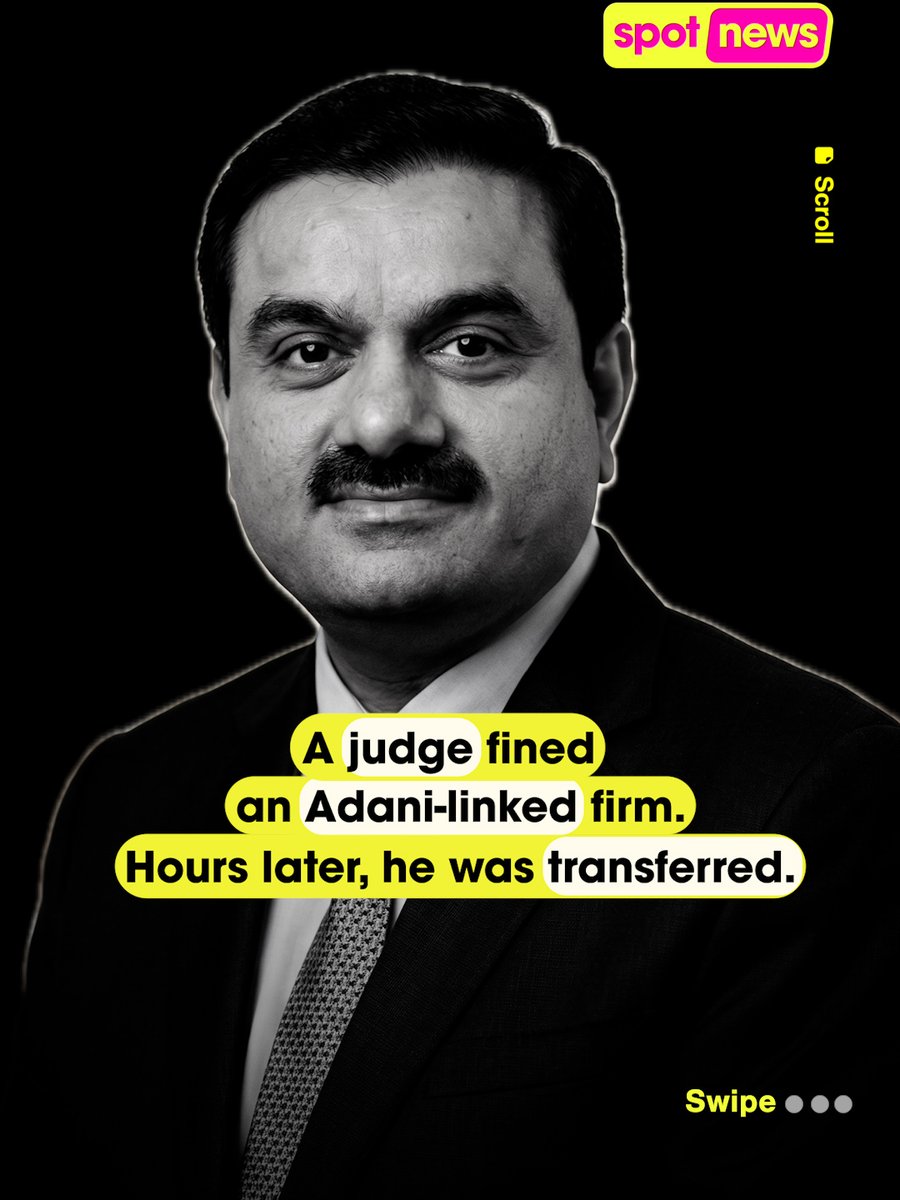
The Decision that shook the Power Circles.
The case was set before Judge Dinesh Kumar Gupta, who was officiating a high stakes financial case involving a state owned power company and a joint venture between a joint venture headed by the Adani Group. The court held that the private company had overstated the transportation fees in the tune of Rs 1400 crore to the state of Rajasthan. This was payment of transportation of coal by road, which the court did not consider as part of the initial agreement. This huge financial anomaly was not only raised by the judge but he was also very aggressive towards the corporate organization in question.
For advertisement on our platform, do call at +91 6377460764 or email us at [email protected].
https://www.newsgram.com/corruption-files/2025/12/judge-rules-against-adani-transferred-same-day
Judge Gupta in his order observed in details that the company had not honored its obligation under the contract to construct a railway siding where coal could move. The firm handed the state exchequer the burden of the cost incurred in road transport instead of taking the blame of this failure. According to the court, this action was an effort to gain wrongfully, at the expense of the public money. In order to hold the joint venture responsible, the judge fined the company run by Adani a sum of 50 lakh rupees. In addition to that, he instructed the state government to have the Comptroller and Auditor General (CAG) conduct a thorough audit of the whole deal.
https://muckrack.com/shreegireesh-jalihal/articles
Rapid Government Intervention and Instantaneity.
The developments that followed the delivery of this judgment were quite fast and unexpected to the law observers. Judge Dinesh Kumar Gupta delivered the verdict on the corporate giant just a few hours later yet the Rajasthan government passed an administrative order. The Law and Legal Affairs Department of the state took away his position of Presiding Officer of the Commercial Court. This order then carried out on the same day as the judgment was signed and immediately, there were questions as to the timing and the motivation of the move.
The Rajasthan High Court also intervened the same day on the same in response to the order of the government to reassign the judicial officer. Judge Gupta had been moved out of the capital city of Jaipur, to a district court in a town called Beawar, which is roughly 200 kilometers away. Although the idea of moving the judiciary was a standard administrative process, the speed at which this transfer has occurred was like lighting a fire. Critics and anti-government activists instantly highlighted the fact that the decision to transfer a judge on the same day that such a large negative verdict was made against a politically affiliated company was extremely uncharacteristic.
Coal Transportation Charges Dispute.
The basic meaning of this court battle goes way back into the time of signing of a mining and delivery deal. The agreement was to dig coal off the Parsa East and Kente Basan blocks, located in Chhattisgarh and supply the same to thermal power plants in Rajasthan. It was clearly stated by the agreement that the private operator would have the duty of building a railway siding that would effectively carry the coal. This infrastructure was however not constructed within the right time and thus a costly method of road transportation was resorted to to carry the fuel.
The Parsa Kente Collieries Limited (PKCL) headed by Adani charged the state power generation company with such road transport expenses. These charges amounted to huge figure of Rs 1400 crore over a few years. These bills were paid by the state-owned Rajasthan Rajya Vidyut Utpadan Nigam Limited (RRVUNL) so that power supply would not be disrupted. The legal tussle came about when the private firm subsequently sought interests on payments it believed had been withheld and as such the court was compelled to question the whole system of payment itself.
The judge transfer was not the end of it. The verdict of Dinesh Kumar Gupta was challenged by the higher judiciary instantly. Approximately less than 12 weeks following the verdict, the Rajasthan High Court gave an order of stay on the instructions provided by the commercial court. This stay practically stalled the gathering of the Rs 50 lakh fine and stayed the intended CAG audit on the deal of coal.
This legal action was a temporary solution to the Adani led company, but failed to quell the debate between the population. The case has revived the debate on judicial independence and the role of big corporations in the state government. Legal analysts have argued on whether the commercial court was within its remit to direct a CAG audit, and the rest of them are concerned with how procedurally appropriate the abrupt sacking of the judge was. The saga is a hotspot in the politics and the law world of Rajasthan.