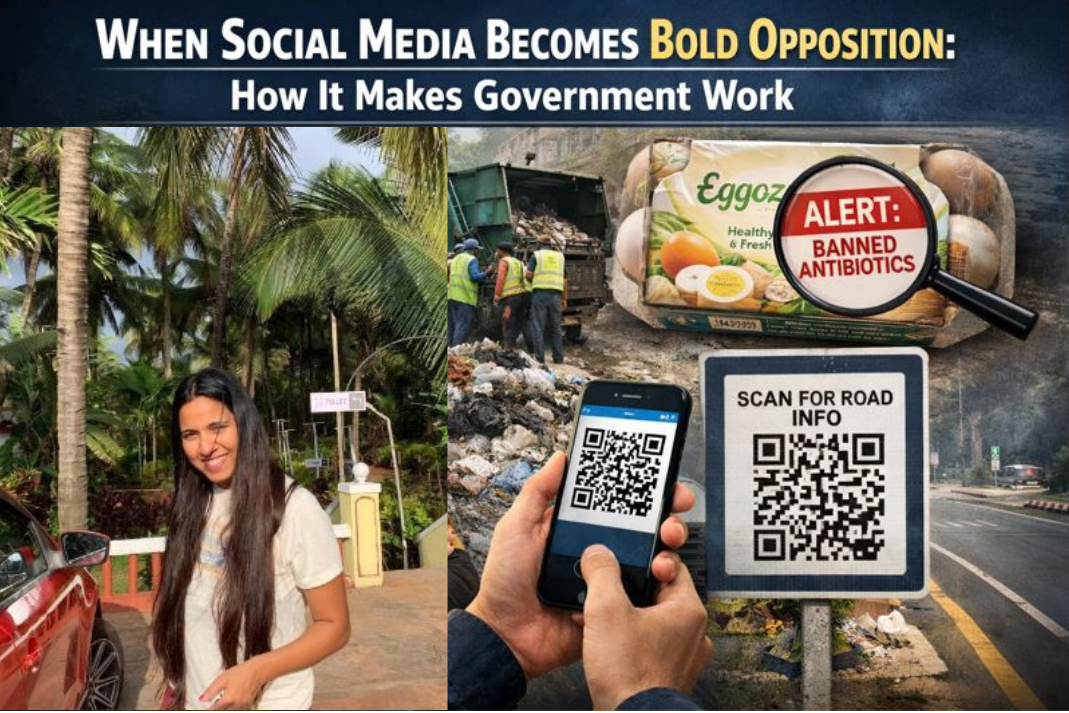
In an age where political opposition is often measured by volume rather than value, Anuradha Tiwari represents a different model of civic dissent – one that compels accountability not through slogans but through solutions. Tiwari has emerged as a consistent civic voice whose interventions do not just generate headlines online but translate into real-world action. Without even holding office, she has repeatedly shown how focused, solution-oriented advocacy can compel institutions to respond.
For advertisement on our platform, do call at +91 6377460764 or email us at [email protected].
1. QR Codes on Roads: Transparency Through Simple Technology
One of Tiwari’s most impactful ideas was deceptively simple: every public road should feature a QR code that citizens can scan to access transparent details about the project – who built it, how much it cost, which contractor executed it, which agency maintains it, and who approved it.
Her viral social media post argued, “If a ₹5 biscuit has all its details printed, why not a ₹100 crore road?” – a framing that resonated widely and sparked widespread calls for infrastructure transparency.
In late October 2025, Union Road Transport and Highways Minister Nitin Gadkari announced plans to introduce QR codes on national highways so commuters can scan them for project costs, officials’ names, and contractor details – a move aligning closely with Tiwari’s idea and an example of citizen pressure shaping public policy.
2. Gurgaon Garbage: From Viral Post to Same-Day Clean-Up
In August 2025, Tiwari drew attention to a stretch of uncollected garbage in Gurugram with a sharp social media post. She published a photograph of the littered road and wrote that she was looking for volunteers who could help “pick up this kind of garbage and dump it right in front of the ministers’ bungalows.”
The message resonated. Users responded with practical offers, including one offering JCB. The post quickly went viral, prompting citizens and activists to discuss waste management and civic accountability. Within hours, the Municipal Corporation of Gurugram (MCG) dispatched teams to clean the area, clearing accumulated waste the same day.
MCG later acknowledged the public concern, noting that regular garbage collection was already part of their duties but that increased attention had expedited the clean-up. The incident showcased how strategic use of social platforms can mobilize public interest and compel administrative response far faster than traditional complaint mechanisms.
3. Food Adulteration and Eggoz Eggs: Spotlighting Health Risks
Tiwari has increasingly focused on public health, especially food adulterations. In early December 2025, she highlighted concerns on social media about potential dangerous carcinogenic substances found in premium eggs produced by the brand Eggoz, alleging the presence of banned antibiotic residues that could pose public health risks.
The claims intensified public debate around food regulation and product safety. In response to the controversy, the Food Safety and Standards Authority of India (FSSAI) instructed its regional offices to collect both branded and unbranded egg samples for nationwide testing to check for prohibited substances like nitrofurans – antibiotics banned in food-producing animals that can have genotoxic and potentially carcinogenic effects. FSSAI’s order includes sending samples to multiple laboratories across the country for comprehensive analysis.
This move marked a rare regulatory escalation triggered partly by sustained public pressure and discourse, illustrating how citizen-led scrutiny can help focus authorities on serious safety concerns rather than allowing them to be buried in noise.
5. The Merit Question: An Uncomfortable but Necessary Debate
Perhaps her most controversial stance is her consistent advocacy for merit and fair opportunity, including her critique of entrenched privilege encapsulated in the idea of “one family, one reservation”. Rather than reducing such debates to electoral rhetoric, Tiwari has pushed for substantive discussion, emphasizing outcomes like fairness, efficiency, and institutional trust. Her voice has helped elevate merit as a serious public policy discussion rather than a fringe topic.
She was among the first civic voices to be invited on a mainstream television podcast to speak openly about the importance of merit in the country. On Republic TV, she explained how ignoring merit across institutions leads to everyday failures such as pothole-related deaths, bridge collapses, pollution, and weak regulation. Her argument was simple: when competence is sidelined, governance suffers.
A Lesson for the Opposition
Anuradha Tiwari’s rise offers a clear lesson to traditional opposition parties: opposition is not only about resisting power; it is about proposing workable alternatives and enforcing accountability. Ranting without solutions may mobilize crowds, but it rarely fixes roads, clears garbage, or compels regulators to act.
Her approach suggests that the most effective opposition today may not always be the loudest but the most precise. By identifying specific failures, offering clear solutions, and leveraging public attention strategically, Tiwari has shown how governance can be improved without occupying formal power.
In doing so, she has redefined what opposition can look like in modern India: silent, sharp, and effective.