Opposition Boss Criticizes New Law on Rural Jobs.
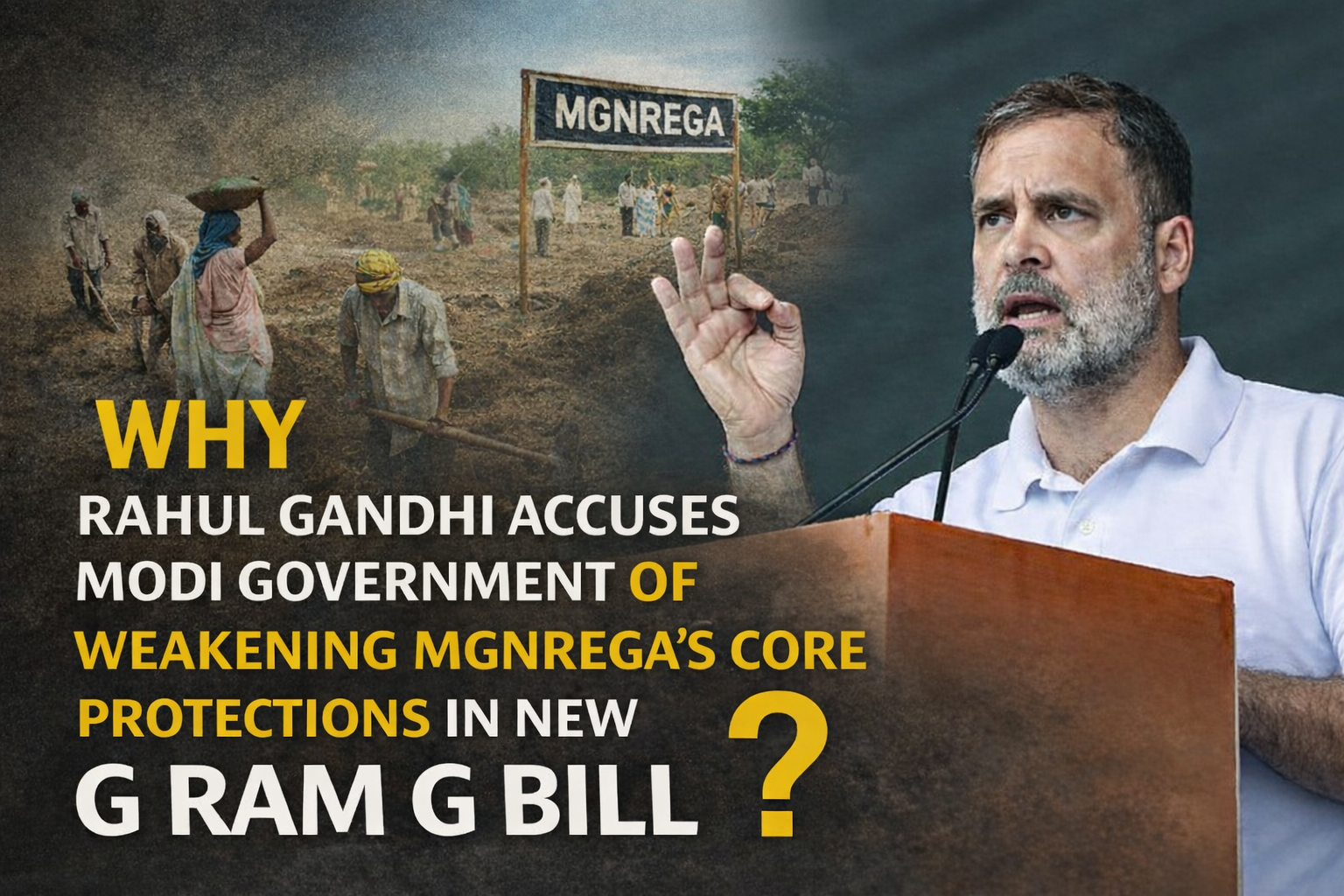
Political temperature in New Delhi is at an extreme level after a new controversial bill was passed. The leader of the congress, Rahul Gandhi, has taken a scathing critique to the new legislation of the Modi government. The name of the said bill is Viksit Bharat Guarantee Rozgar and Ajeevika Mission (Gramin) Bill, 2025. It is commonly known as the VB-G RAM G Bill as it attempts to substitute the old MGNREGA that is 20 years old. Rahul Gandhi has described this move as an out right attack on the rural poor and their means of livelihood. According to him, the new law is viewed as successful in destroying legal protection of work which millions of people were dependent on.
For advertisement on our platform, do call at +91 6377460764 or email us at [email protected].
The Opposition Leader aired his objection by giving a comprehensive speech in the social media. He charged the central government with reversing twenty years of gains within one day. In his opinion, the initial MGNREGA was a lifeline to the rural India when the economy was in dire need. He particularly remembered the Covid-19 pandemic where the scheme rescued millions of individuals who were in hunger. The government can be accused of undermining the social contract within the rural areas by substituting this strong safety net with the new VB-G RAM G Bill. His main argument is that the new bill eliminates the right-based system of the initial act.
Demand-Driven to Supply-Driven Model.
One of the core aspects of criticism by Rahul Gandhi is the wholesome structural shift in the nature in which jobs are offered. The uniqueness of MGNREGA was that it was a demand-driven scheme, i.e. legally the government should give a citizen work as long as one requested it. The new VB-G RAM G Bill, though, is receiving criticism as making this an item of rationed scheme. Those who oppose it believe that now jobs will be based on the budgetary allocation of the government and not on the real needs of the citizens. This change essentially changes the status quo of the relationship between the state and the rural worker.
In the previous legislation, the government was supposed to pay an unemployment allowance after fifteen days of not being able to offer a job. Rahul Gandhi is afraid that the new act is watering down this accountability with a number of conditions. In his opinion, work capping and development of bureaucratic obstacles are the purposeful methods of refusal to employ. This form of supply induced strategy enables the government to dictate the amount of work produced depending on the money available. To the rural poor it translates to no longer being sure of relying on the work of the government when times are lean.
Onerous Financing Division to States.
The change in the funding patterns is another significant area of concern that is raised by the opposition. The VB-G RAM G Bill suggests that there should be a 60:40 division on the scheme between the Centre and the States as a source of funding. In the past, the federal government had been paying the full wages of the unskilled manual labour. This change presents a huge financial burden to state governments most of which are already operating under fiscal strains. Rahul Gandhi claims that this is anti-state in intent and it does not support the spirit of cooperative federalism.
The central government is capping the extent of the program by coercing the states to make forty percent payments of the wage bill. Weaker states that have less revenue production will find it difficult to meet the central grants. This may create the scenario of being denied work due to the empty state treasury. The opposition believes it is a calculated move to make the scheme starve as it moves the blame to state administrations. It puts an unequal playing field whereby employees in richer states may receive more work than employees in poor regions.
Delhi has been centralizing power.
Another problem that the leader of the Congress has also pointed out in the new bill is excessive centralization. The law stipulates that the rural development plans should be merged upwards and incorporated into the national structures. According to Rahul Gandhi, this removes power to the Gram Sabhas and concentrates it at the center at Delhi. The initial MGNREGA has been commended due to giving local village councils the power to choose the work that had to be done. The Viksit Gram Panchayat Plans of the new bill are perceived as an imposition by a top-down approach that does not take into account the realities on the ground.
The very nature of this centralization is considered to be anti-village since it does not take into account the special needs of different rural communities. Someone in the capital, as a bureaucrat, might not know the water conservation requirements of a village in Jharkhand, in the distant regions. The government exposes itself to the dangers of making assets that are not beneficial to the local people because of the process of standardizing the planning process. Rahul Gandhi believes that the real power of the rural India is a decentralized system of governance. The reduction in the power of the Gram Sabha is observed to be an assault to the foundation of Indian democracy.
Improvement on Women and Marginalized Communities.
Another important issue of the accusations of Rahul Gandhi is the social effect of the new bill. He pointed out that women are the largest beneficiaries of the rural employment guarantee of the past. Under the old scheme, women always worked over a half of the total person-days produced. Through the proposed introduction of a rationed system, it is feared that women will be the initial ones to be sidelined in the job market. When there is a dearth of jobs, patriarchal values in most cases favor men to snatch a few jobs.
Dalits, Adivasis, and landless labourers will also be likely to be disproportionately adversely affected by the new rules. These groups usually do not have any other income source but are forced to survive on government job. The establishment of digital and mandatory attendance along with the introduction of complicated biometric demands presents an added obstacle to them. The new law, Rahul Gandhi threatened, gives more reasons to deny employment to the most vulnerable. In his argument, he believes that the government is effectively disempowering the advantage that these marginalized communities have acquired over the decades.