For advertisement on our platform, do call at +91 6377460764 or email us at [email protected].
The protracted political controversy over the Indian military’s acquisition of aircraft has resurfaced. Congress leader Rahul Gandhi has launched a new attack on the central government’s recently approved defence plans in public. His complaint is mainly against a big new procurement plan of Rs 3.25 lakh crore.
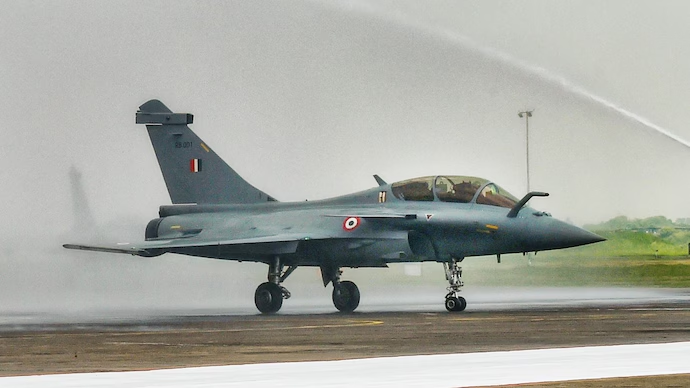
The defence package is meant to enable the IAF to acquire another 114 Rafale multi-role fighter planes.
Gandhi’s attacks on the government’s dealings with French aircraft maker Dassault Aviation have always focused on aerospace contracts. He recently made similar remarks about financial transparency, cost inflation and the absence of full technology transfers. He highlighted that the multibillion dollar transaction is more beneficial to the foreign companies than to support India’s domestic aerospace engineering industry.
This is the Historic Size of the New Acquisition Plan.
The amount of the new defense buy has been so huge as to be the largest capital procurement programme in the history of modern India. The formal process has taken another massive stride when Defense Minister Rajnath Singh gave the Acceptance of Necessity (AoN) for Multi-Role Fighter Aircraft (MRFA) programme in the presence of Defense Secretary Shri Nirmala-Sreeram Siraj.The formal process had taken a giant leap when Defense Minister Rajnath Singh gave the Acceptance of Necessity (AoN) for Multi-Role Fighter Aircraft (MRFA) programme in the presence of Defense Secretary Shri Nirmala-Sreeram Siraj.
The exercise comes as part of a comprehensive military upgrade programme of Rs 3.60 lakh crore which also involves combat missiles and pseudo-satellites at a high altitude.
The Rafale contract has been discussed on specific terms and India plans to buy 18-24 of the 4.5 generation fighter aircraft from France in a “fly away” configuration. This was an initial import and is designed to help during the short term in order to fill gaps in immediate operational security along the borders. Remaining orders for the large order (about 90-96 aircraft) are to be made in India through a strategic partnership with a local defense production partner.
How the Air Force’s Urgent Need reduced to Shrinking Squadrons.
The government has cited a shortage of capability in the Indian Air Force to rationalise the huge financial expenditure. After the whole MiG-21 fleet had to be retired from the service, the number of fighter squadrons has come down drastically.
There are only 29 squadrons on active service in the Air Force at present.
It is the lowest operational level since the 1960s and well below the 42 squadrons that are required for national defence. The military has been repeatedly alerted to structural weaknesses arising from the failure to carry out the country’s air defence manufacturing program, especially that of Tejas Light Combat Aircraft (LCA) Mk-1A. The government believes that the additional Rafale aircraft is the quickest and most effective solution to filling these loopholes with a proven platform that can do the job.
The debate on Make in India and Local Parts.Debate on Make in India and Local Parts.
One key issue that pits the political opposition against the ruling administration is the true extent of local manufacturing. The defense ministry has indicated that the indigenous content of the aircraft manufactured in India would be approximately 50 per cent.
But opponents of the opposition are very skeptical on these claims.
According to Gandhi and his policy advisors, previous agreements did not achieve true ‘technological independence’ as India remains dependent on OEMs from abroad for key parts of their engines and source codes of sensitive technologies. They note that although assembly lines could be established here, the key IP and top-notch manufacturing skills remain within France. The opposition argues that this provides an ongoing situation of dependency for maintenance, repairs and future improvements.
An increasing Air Force of French Fighters
The current proposal will, if it passes the final hurdles in the process, such as price negotiations with the war industry and Cabinet Committee on Security headed by Prime Minister Narendra Modi clearance, further ensure that Rafale is the mainstay of the frontline air power of the country.
The air force has already deployed 36 Rafale aircraft in two squadrons in Ambala and Hasimara.
Further, the Navy has already signed a separate deal worth Rs 63,000 crore for 26 marine variant Rafale-M fighters that will be deployed on its aircraft carriers, INS Vikrant and INS Vikramaditya. The widespread use in a variety of military services has attracted a lot of criticism from oppositional parties, which say that it weakens competitive bargaining power as all of India’s strategic eggs are placed in a single basket of foreign defence.