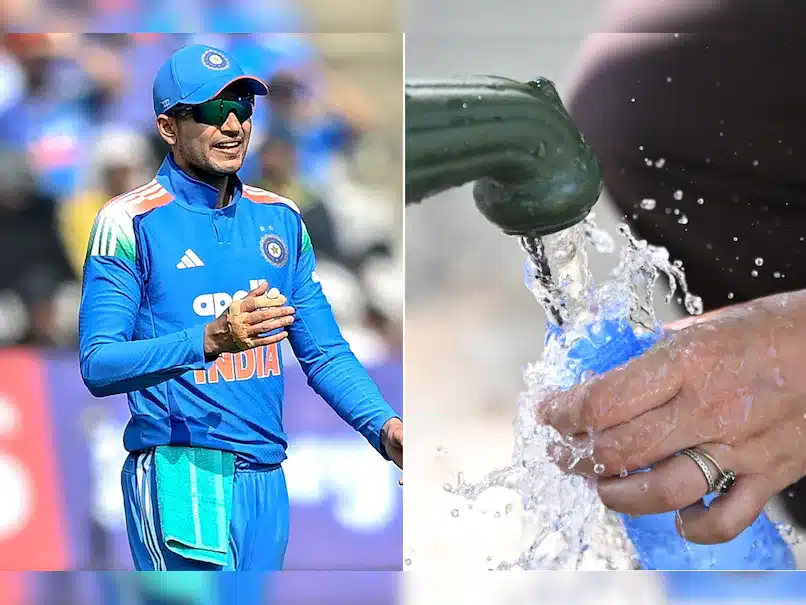
Health and safety measures have increased in the presence of the Indian cricket team in Indore where they are about to play the third and final One Day International against New Zealand. Although the attention is still on the high-stakes series decoder in the Holkar stadium, off-field preparations have received a great deal of attention because of a localized health issue. The news coming out of the camp is that the team management and individual players are not risking on hydration and dietary intake. Special focus is being given to water consumption after some recent reports of water pollution cases in some localities of the city.
For advertisement on our platform, do call at +91 6377460764 or email us at [email protected].
At the head of such precautionary measures is Indian captain Shubman Gill who is said to have travelled with a special water purification system. A report given by NDTV reports that the Indian captain carried with him a costly water purifying machine, which could cost about Rs 3 lakh, to his hotel room in Indore. It is claimed that this device can re-purify even the RO-treated and packaged drinking water, to make sure that the last impurities, bacteria, or heavy metals are removed. As long as the team is lodged in a five-star establishment that meets the best hygienic practices, this extra measure emphasizes the obsessive level of consideration being given to the health of the players in this tour.
Local Health Situation and Active Surveillance in Indore.
This increased sensitivity in respect of water safety goes hand in hand with an extreme civic problem of a certain section of Indore that is being experienced at the moment. Despite the fact that Indore has always been known as the cleanest city in India, some disturbing reports on water-borne diseases have reportedly occurred in the Bhagirathpura area during the past few weeks. According to the local media, sewage pollution in the drinking water supply systems has caused a major health crisis in the said locality and there have been confirmed cases of hospitalizations and deaths attributed to the intake of untested water.
Although the hotel of the Indian team and the Holkar Stadium are many miles away in terms of the residential areas that the outbreak has been afflicting, the news on the outbreak has allegedly made the team management to become more restrictive. A few lives have been lost as a result of the health crisis in the city which left the city in a state of caution. The fact that the news of the contamination is close to the match venue could probably have been the catalyst to these increased personal safety precautions. It is customary that professional athletes are hyper-vigilant of environmental health contagions, with even a diarrhea paling a central figure out of a defining game.
Contrasting Reports of the Motivation of the Measure.
The story is mixed on whether installing the purification unit is a direct reaction to Indore crisis or it is a continuation of a long time practice. According to some sources, the machine was actually bought during this leg of the tour as a result of the news concerning the water quality that prevailed. Such reports put the decision in perspective of a reactionary approach to get the captain and the team covered against any threat of dangers involved in local water supplies regardless of the presence of filtration systems in the hotel.
Nevertheless, there are other reports, such as that of Cricbuzz, that give a contrasting idea on the issue. These sources help to understand that the purpose of carrying a personal water purification system was an habit that Shubman Gill developed way before the Indore series. It is thought that after recovering dengue fever at some time in the past the cricketer was so choosy with regard to the sources of hydration and his immune system. In this respect, the device belongs to his standard travel pack to international and domestic tours, and not an impulse buying caused by the events in Indore. This is a story that proposes the fact that the time is coincidental, but the procedure is in line with the strictness of the lifestyle requirements of the contemporary world of international cricket.
Expansive Team Procedures and Food restrictions.
It is not just the case of water purification gadgets, with the board of control of cricket in India (BCCI) having allegedly undertaken extensive dietary protection on the complete team. The team is also supported by a trained chef to ensure reduction of risk associated with food-borne diseases by supervising all the meals. This standard provides assurance that players will be fed using specific nutritional and hygienic standards that bypass the normal hotel catering practices whereby the risks of cross-contamination may be a bit greater.
The elder players are reported to follow strict and personalized diets plans to stay in the optimum physical state. As an example, the eating schedule of Virat Kohli is said to be based on grilled vegetables, soups, and South Indian food, with no intake of spices that are very heavy or raw food that may be a gastric threat. On the same note, other players have limited themselves to cooked lentils, boiled eggs, and curd in order to make them easily digested. Kohli also has a reputation of bringing his own stock of imported natural spring water which makes him even less dependent on the local. These united efforts are indicative of professional setting in which the biological security is taken as serious as the on-field strategy.
High Stakes in the Holkar Stadium.
The high concentration on the fitness of players is caused by the importance of the match ahead at the Holkar stadium. The three-match ODI series between India and New Zealand is tied in 1-1 making the Indore a virtual final. India had won the first game easily but New Zealand had made a good comeback in Rajkot, with the team majorly driving back the game through the century of Daryl Mitchell. The management of the Indian team cannot lose any of the players to avoidable diseases such as gastroenteritis or dehydration with the series on the line.
The holkar stadium is traditionally remembered to be a high scoring field with a bat friendly surface and relatively small boundaries. The pitch curator has suggested that the pitch is going to be conducive to the batsmen once again implying that the game will be physically exhausting to the bowlers and the fielders. Under these extreme conditions of high intensity, hydration becomes a very important issue of performance. Cramps and lack of concentration can be caused by dehydration or electrolyte imbalance which may be harmful in a match that is likely to have more than 600 runs recorded.